Writing a Book About Your Own Life — Where to Start and How to Proceed
4 June 2026
More and more people want to write a book about their own life — or about a loved one's life, their family, their home region or their life's work. The stories are there, the memories are plentiful, and the idea of making your own book has been maturing in your mind for years. Yet most people never begin. The reason is almost always the same: they don't know where to take hold of the whole undertaking.
This guide is meant for exactly that moment. It isn't yet a single writing tip or a point of style, but an overview map: what "writing a book about your own life" actually means, what starting points you have to choose from, in what order it pays to proceed, and where to find more detailed instructions for your particular situation. We use this page as a gathering point — a place to start from and move on to the right in-depth article.
What can "your life as a book" mean?
Before you think about how you write, it's worth figuring out what you are writing. A book about your own life can be several different things, and the type affects everything that follows — the angle, the structure and the tone.
- An autobiography is your life story in full, usually from childhood to the present. You are both the narrator and the main character. If your goal is to record your whole life arc, writing an autobiography is the most natural starting point.
- A memoir is a freer form: selected memories, themes and periods, not necessarily your whole life. A memoir lets you pick exactly the moments that feel meaningful. Read more about writing memoirs.
- A biography tells someone else's life — your parent's, grandparent's or spouse's, for example. As the writer, you research and interpret another person from the outside. There's a dedicated guide for this: writing a biography.
The lines aren't sharp, and many books combine features from more than one type. The most important thing is to recognise whether you're telling your own story or someone else's, and whether you aim to cover the whole life arc or selected pieces of it.
If a term along the way is unfamiliar — transcription, typesetting, print on demand, self-publishing — the glossary explains them all briefly in one place.
Choose your own starting point
Most often a book doesn't begin from a genre but from a life situation: there is a particular person, relationship or subject you want to capture. Below are the most common starting points, with a link to a more detailed guide for each. Find the one that describes you best — and start there.
A whole life story
- Writing an autobiography — your own life story from beginning to end.
- Writing memoirs — selected memories and themes, with no obligation to cover everything.
- Writing a biography — another person's life as a book.
- How to structure a life story — for when the type is clear but you're wondering in what order to tell the story.
A particular person or relationship
- A book for your grandchild — a book a grandparent writes directly to their grandchild.
- A book about your child's childhood — a parent capturing memories of a child's early years.
- Parenting wisdom for your teenager — what you'd want to tell your child before they're ready to hear it.
- A book about a deceased loved one — a memorial book that preserves a dear person's story.
- How to write a biography about someone else — when the subject is alive and present: asking, consent, interviews, and whose voice the book is in.
- Your love story as a book — a couple's shared story as an anniversary or wedding-day gift.
Family, community and tradition
- Family history as a book — your family's stories for future generations.
- Local history as a book — the memories of your home region and village, preserved.
- Association history as a book — the story of a society or organisation.
- Recording elders' stories — how to interview the older generation and turn their memories into a book.
- Family reunion stories — a summer gathering is the best moment of the year to record your family's stories.
- A family cookbook with stories — your family's recipes and the memories behind them, in one volume.
If more than one of these feels like yours, that's fine. You can start narrow with a single subject and expand later — in fact, narrowing down is one of the best ways to get a book started at all.
Writing a book about your own life, step by step
Whatever the type and subject, the process moves through the same stages. Here is the whole journey in outline.
1. Narrow the subject and the angle
The first and most important decision isn't "what do I write about", but "what do I not write about". A whole life is too big a subject for one book, and trying to cram everything in often means nothing gets told properly. Choose an angle: a particular period, a relationship, a theme or a turning point. A narrowed book is almost always better than one that tries to cover it all.
2. Gather memories and material
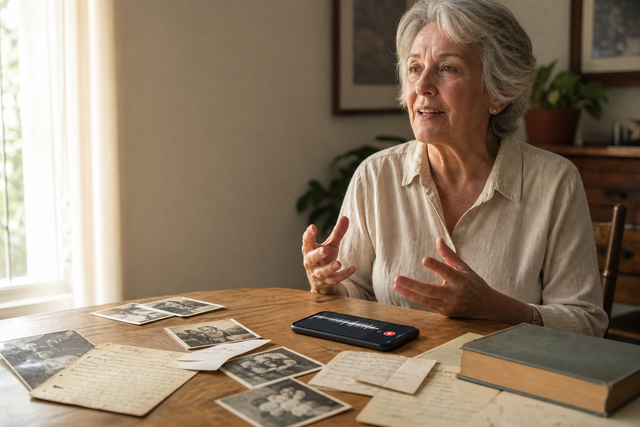
Once the angle is clear, collect the raw material: memories, photographs, letters, diaries, documents. At this stage you don't yet write finished text — you gather the pieces. For many people the easiest way to reminisce is to speak out loud — to tell the stories as they come to mind, without the pressure of shaping them straight into written form.
3. Choose a structure
Once you have material, the story needs a shape. Does the book proceed chronologically from childhood to the present, or is it divided by theme? Does it open with a gripping scene? This is worth tackling separately — we gathered five working models and guidance on choosing between them in the article on how to structure a life story.
4. Write and organise into chapters
Now the memories turn into chapters. A good rule of thumb is one chapter, one stage or idea. Don't aim for perfect text on the first pass — the main thing is to get the story onto the page, after which you can polish it. Many people get stuck right here, because the blank page is intimidating; that's why starting by speaking (step 2) lowers the threshold decisively.
5. Finish and publish
Finally the text is proofread, laid out and published — as a printed book, an e-book or an audiobook. There's a dedicated guide to this last stage, from manuscript to finished book: speak your book into being. A printed copy can be ordered straight from Vellu and delivered to you; see how to create your own printed book. And we've broken down the full cost of the project in how much does it cost to make your own book. If you want to sell the finished book, read can I sell a book made with Vellu.
The most common obstacles — and how to get past them
Almost everyone considering a book about their own life runs into the same three obstacles.
"I'm not a writer." This is the most common reason for never starting — and at the same time the most pointless. You don't need literary talent to record your own life. You need memories and the will to share them. Narration that sounds like you is more valuable than artificially "literary" prose.
"I don't know where to start." The answer is narrowing down: don't start from your whole life, start from a single memory. One story told leads to the next, and before you know it you've accumulated a chapter's worth of material.
"I don't have time to sit down and write." Settling at a desk and shaping text takes time that few people have. But speaking doesn't: you can tell a memory out loud on a walk, in the car or on the sofa in the evening. This is exactly why more and more people make their book by speaking.
The easiest way: speak the book together
If the obstacles above feel familiar, here's the good news: a book no longer has to be written word by word on a blank page. You can tell it out loud, and AI handles the rest.
In practice you record your memories in free order — the way you'd tell them to a friend. Vellu.ai transcribes the speech, organises the memories into periods and themes, suggests a structure for the book, and turns the spoken story into fluent text. You decide what makes the cut and what doesn't. This way the most laborious part of the whole process — filling the blank page — falls away, and you concentrate on what you do best: telling stories.
This suits you especially well when writing doesn't come naturally but you have stories to spare — that is, exactly those who would otherwise leave the book unwritten. Read more about how memoirs come about with the help of AI, by speaking. And if you're wondering whether plain ChatGPT would do the job, we've compared a chatbot and a purpose-built book tool in can you write a book with ChatGPT.
Where do you start today?
A book about your own life isn't finished by planning but by beginning. So do this:
- Choose a starting point. Look at the list above and pick the subject that resonates most. Open its own guide.
- Narrow the angle. Don't try to tell everything — choose one period, person or theme to set off from.
- Tell the first memory. Write or record one story today. That's the first page of your book.
The most important thing isn't a perfect plan but that the story begins turning into words. Start from a single memory — the book grows from there.
Frequently Asked Questions
How do I start writing a book about my own life?
Start by narrowing down. Don't try to tell your whole life at once; choose one angle: a period, a relationship, a theme or a turning point. Then gather the memories — many people find it easiest to do this by speaking out loud — and write one story to completion. The first memory you tell leads to the next, and the whole takes shape along the way. You'll find more detailed instructions in the guides linked from the starting-point list on this page.
What's the difference between an autobiography, a memoir and a biography?
An autobiography tells your own life in full, usually chronologically. A memoir is a freer form that focuses on selected memories and themes. A biography, in turn, tells someone else's life as written by you. The same story can be any of these — what's decisive is whether you're telling your own story or another's, and whether you cover the whole life or selected pieces.
Do I need to be good at writing to make a book about my life?
No. You don't need literary training or talent to record your own life. You need memories and the will to share them. The value of your story is in its content, not in the ornateness of its style — and your own, authentic narration is more valuable to a reader than artificially literary text. If writing feels hard, you can also tell your book by speaking.
How long does it take to write a book about your own life?
It depends entirely on the scope and the way you work. A narrowed memoir can come together in a few weeks, while a full autobiography covering an entire life arc can take months. The single biggest accelerator is how easy it is to start: when you gather memories by speaking onto a recording, material accumulates far faster than by filling a blank page. More important than speed, though, is that the project doesn't stall — even small, steady progress reaches the finish line.
Can I make a book about my life by speaking?
Yes. You can record your memories in free order, and AI transcribes the speech, organises it into chapters and turns it into fluent text. Vellu.ai is built for exactly this: it turns spoken memories into a book that can finally be finished as a printed book, an e-book or an audiobook. For many people this is the easiest way, because it removes the most laborious stage — filling the blank page.