Family History as a Book — Preserve Your Family's Stories for Future Generations
20 March 2026
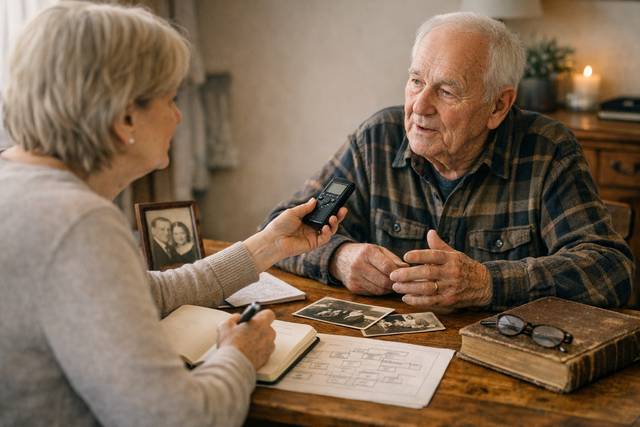
Genealogy is one of Europe's most popular hobbies. Parish registers, census records and other archives are full of names, dates and places. But family trees only tell you who lived where and when — they do not tell you what life was like.
The real richness of family history lies in the stories. Grandfather's accounts of the war years. Grandmother's memory of the first electric light. An aunt's story about how the family moved from the countryside to the city. These stories complete the family tree and turn ancestors into real people — not just names on paper.
Recording a family history as a book is a gift whose value only grows with time. In this guide we walk through how to gather family history, how to conduct interviews, and how stories become a book.
Family history is one way to turn life stories into a book. For the whole picture of the different starting points and the full process, see our overview guide, writing a book about your own life.
Why it is worth recording family history right now
Oral tradition is breaking
In every family there are still people who remember things no one else knows. They know why grandfather moved from one region to the capital, how the family survived the lean years, who was the family's best storyteller, and what kind of character great-grandmother had.
When those people are no longer here to tell, the stories vanish for good. A name and dates remain in the family tree, but the person behind them disappears.
Family trees raise questions
If you have done any genealogy, you know the feeling: you find a name in an archive and want to know more. Who was this person? How did they live? Why did they do what they did? A family history book answers exactly those questions — at least to the extent that living memory reaches.
A gift for the family reunion
In many families, reunions bring together distant relatives. A family history book is the perfect gift to share at such an occasion. It connects family members and creates a shared identity.
A legacy for future generations
Your grandchildren and their children may one day read a book that tells them about their roots — real people, real events, real feelings. It is a legacy that does not wear out or grow old.
Combining genealogy with oral history
The best family history book combines two different sources: the facts found in archives, and the stories that are told aloud. You need both.
Archive sources
Across Europe, genealogists have access to a remarkably rich set of archives:
- Parish registers — births, baptisms, marriages, burials. Often available digitally through national archive services.
- Census and tax records — show who lived where.
- Migration records — track movement between parishes and across borders.
- Military records — service rolls, war diaries, lists of the fallen.
- Maps and land registers — the ownership history of farms and properties.
From archives you get the skeleton: who, where, when. But the story only comes alive when you combine these facts with oral memory.
Oral memory
Oral history is what archives cannot give you: how things felt, what kind of people your ancestors were, why decisions were made, how everyday life worked. These stories live only in people's memory — and they have to be captured through interviews.
How to gather family history — practical guidance
1. Start with what you already know
Write down everything you yourself know about the family's history. What have your parents told you? What did your grandparents tell you? Which stories have stuck with you?
If you have done genealogy, use the family tree as a framework. It helps you see which relatives are worth interviewing and which periods need more information.
2. Identify the key people to interview
In every family there are people who know more than others. They are often:
- The eldest members of the family
- Those who have always been interested in family history
- People who still live in the family's original area
- Cousins, aunts or uncles who remember the previous generation's stories
Draw up a list and start with those whose interviews are most urgent — usually the oldest relatives. If interviewing an elderly loved one feels daunting, see our interview guide.
3. Prepare carefully for the interviews
A good family history interview is a warm conversation, not an interrogation. Preparation makes it more fruitful.
Before the interview:
- Find out what archives reveal about the interviewee's family — names, places, dates
- Look out old photographs related to the interviewee's life
- Think about what information gaps you have and what you would like to know
Example questions:
- "Tell me about your childhood — where did you live, what was your home like?"
- "What kind of people were your parents?"
- "How did your parents meet?"
- "What kind of traditions did your family have?"
- "How did the war / hard times / moving affect your family's life?"
- "What is the funniest or most moving memory you have of the family?"
- "Is there a particular story you would especially like to preserve?"
- "What would you like today's young people to know about your family history?"
4. Record the conversations
Don't rely on notes — record everything. A phone's voice recorder works well. A few practical tips:
- Announce that you are recording and ask permission. Most people are pleased to have their stories captured.
- Keep the atmosphere relaxed. Offer coffee, sit comfortably, let time pass.
- Don't interrupt. Once the interviewee gets going, let them talk. Save follow-up questions for the pauses.
- Use old photographs. Leafing through a photo album together is an excellent way to trigger memories.
- Record several sessions. The first session brings a lot of material, but the second often surfaces new memories that the first conversation woke up.
5. Gather material from different sources
A family history book grows richer when you combine different sources:
- Interviews — oral memory, stories, recollections
- Genealogy — names, dates, places, family trees
- Photographs — family albums, group photos, landscapes
- Letters and diaries — if any have been kept
- Official documents — parish records, migration certificates, employment records
Structural options for a family history book
The right structure has a major effect on how readable and engaging the book becomes. Here are four options:
Chronological
The book moves in time order: the family's earliest known members → successive generations → the present day. This is the most traditional and clearest approach. It works particularly well when the family's story forms a clear continuum.
Person-by-person
Each chapter focuses on one person or family. This works well when you have interviewed several relatives and each has a strong story of their own. It resembles a collection of profiles — and a single person can also become a full biography.
Thematic
Chapters cover different themes: the war years, farming, migration, schooling, holiday traditions. This works when the same themes recur across several relatives' stories and you want to compare experiences from different angles.
Place-by-place
If the family has lived in several locations, the book can be organised by place: "The family in the old parish", "Moving to the regional town", "A new beginning in the capital". This suits families whose story is strongly tied to places, and is closely related to recording local history.
Conflicting memories — a richness, not a problem
When you interview several relatives, you will inevitably notice that people remember the same events differently. Two siblings tell different stories about their childhood home. An uncle remembers grandfather as gentle, an aunt as strict.
This is normal and human. Conflicting memories do not need to be resolved — they can be included in the book as they are. "Anna remembers the summers as sunny and full of games with the neighbours' children. Marco, by contrast, remembers the harsh winters and the long walks to school." Both are true — they simply describe different experiences of the same time.
Tips for a successful family history book
- Start small. Don't try to capture the whole family's history at once. Start with one branch or one generation.
- Record everyday life, too. Big events matter, but everyday details — what was eaten, how laundry was done, what games children played — bring history to life.
- Ask about feelings. Don't just ask what happened, but how it felt. "What was it like to leave the family home?" is a better question than "When did you move?"
- Add a family tree as an appendix. A family tree at the back helps the reader keep track of who is related to whom.
- Record your sources. Note down who told which story and when. This adds to the book's value in the future.
- Fact-check. Let the finished text circulate in the family for comments before publication. Someone always remembers a detail the others have forgotten.
A family history book brings people together
A family history project is at its best when it is a shared undertaking across the whole family. When representatives of different branches take part in interviews and gathering material, the project creates connections between relatives. Many people say that making a family history is as rewarding as the finished result.
And as you collect the family's history, you may notice that your interviewees also have their own memoir to tell — a story that deserves a book of its own.
The finished book is something you can hold in your hand and pass on. It tells future generations who we were, where we came from and what we valued. It is the finest legacy you can leave.
Begin capturing the family's stories — interview your loved ones and turn the family history into a book that passes from generation to generation.
Frequently Asked Questions
How is a family history book different from genealogy?
Genealogy collects facts: names, birth dates, dates of death and places. A family history book complements these facts with stories — how life felt, what kind of people your ancestors were and what everyday life was like in different eras. The family tree tells you who lived; the family history book tells you how they lived.
How many relatives should I interview?
Just 3–5 interviews already give a good basis for a book. The more branches of the family you interview, the more varied the book becomes. Prioritise the oldest relatives — their memories are the most irreplaceable and the most urgent to record.
Can I write a family history book even if I don't know much about my family's past?
Absolutely. Often the best starting point is precisely not knowing — curiosity is the interviewer's most important tool. Start by interviewing your oldest relative and let their stories guide you. Archive sources can be added later.
How do I handle relatives' conflicting memories?
Conflicting memories are a richness, not a problem. The book can include several versions of the same event — "Anna remembers it this way, Marco that way." This makes the book authentic and multi-voiced. There is no need to resolve memories or pick one "correct" version.
How much does it cost to make a family history book?
Costs depend largely on whether you do the work yourself or use professional help. AI tools such as Vellu.ai significantly reduce the cost of transcription and writing. Printing costs vary with the print run — print-on-demand makes even a small batch possible without large upfront investment.