Writing Memoirs — A Guide to Recording Your Life Story
20 March 2026
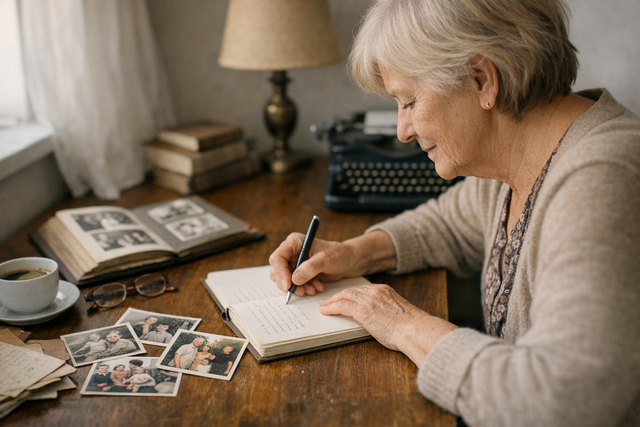
Every person has a story to tell. The experiences, insights and memories accumulated over decades form a unique life story that deserves to be preserved. Many dream of writing their memoirs, but getting started feels overwhelmingly difficult.
Perhaps you too have thought that you should write memoirs for your children and grandchildren. But when you sit down at the computer, a blank page stares back, and the words refuse to find their way to the keyboard. You are not alone — this experience is very common.
Writing a memoir does not, however, require a novelist's gift. In this guide, we walk through how memoirs come into being — from structure to content, from getting started to the final polish.
A memoir is one way to turn your own life into a book. For the bigger picture of the different starting points and the whole process, see our overview guide, writing a book about your own life.
Why writing memoirs feels difficult
People put off writing their memoirs for years on end. There are many reasons:
- Writing is technically demanding. Producing good prose takes practice, and many feel they cannot write well enough.
- Getting started is the hardest part. Where do you begin? With childhood? With the most important turning point? The structure feels impossible to grasp.
- The pursuit of perfection is paralysing. Many fear that their story is not interesting or meaningful enough for others.
- Time slips by. Writing memoirs the traditional way can take years, and the project easily stalls.
These obstacles need not stop you, though. The most important thing is to understand that memoirs are not a work of history — they are your experience, told in your own words.
What to include in your memoirs
Writing a memoir becomes easier when you think in advance about what you want to tell. Your memoirs do not need to cover your entire life. In fact, the best memoirs focus on what has been meaningful.
Turning points
Which moments changed the direction of your life? Your first job, moving to a new town, marriage, the birth of a child, a change of career — these are the knots of the story, around which the narrative naturally takes shape.
Everyday life and detail
Big events matter, but the small details of daily life are what make memoirs come alive. What was Christmas morning like in your childhood? What did your grandmother's kitchen smell of? What did people listen to on the radio in the evenings? These little things spark the joy of recognition in the reader.
People
Memoirs are fundamentally a story about people. Describe the people who have shaped your life — parents, teachers, friends, your partner. What were they like as human beings? What did you learn from them?
A portrait of the era
Your memoirs also tell the story of the time in which you lived. How was daily life different in the 1960s? What was youth like before the internet? These descriptions are priceless for future generations.
Feelings and insights
Don't only tell what happened — tell how it felt. What did you think at the time? What do you understand now that you did not understand then? Honesty and vulnerability are what make memoirs moving.
The structure of a memoir — four options
One of the biggest challenges in writing memoirs is choosing the structure. There is no single right way to organise the story; the choice depends on what kind of story you want to tell.
Chronological structure
The most traditional and clearest approach: the story moves from childhood to the present in time order. This works particularly well when you want to tell a whole life arc, or when events follow naturally from one to the next.
Suited to: A life with a clear arc — for example, the story of a generation that moved from the countryside to the city.
Thematic structure
Instead of moving chronologically, you organise memories by theme: family, work, hobbies, friendship, losses. Each chapter deals with one theme across your entire life.
Suited to: When you want to go deep into specific areas of life and reflect on how they evolved over time.
Episodic structure
You pick the most important moments and tell each as an independent story. The chapters do not need to be chronologically connected — they are like a collection of short stories from your own life.
Suited to: When you do not want to tell your whole life story, but a handful of key moments that are especially meaningful.
Frame narrative
You begin in the present and return to memories through that lens. For instance: "I am standing now in front of this house, and I remember how it all began..." A frame narrative gives memoirs depth and perspective.
Suited to: When you want to weave past and present together and make your memoirs reflective.
How to start writing your memoirs
1. Don't start at the beginning
A common mistake is to try to write in order from childhood onwards. Start instead with the memory that is most vivid in your mind right now. It can come from any point in your life. Once you have one story written down, the threshold for continuing drops considerably.
2. Make a list of memories
Write down 20–30 memories, events or people that come to mind. Don't censor — record everything. This list serves as a bank of material from which you can later choose the most important.
3. Speak before you write
Many people find that telling a story out loud is easier than writing it. Try speaking a memory into your phone's voice recorder — talk as you would to a friend. That way you capture the story without the pressure of the blank page. Tools such as Vellu.ai can turn these recordings directly into text and shape them into reading form. Read more about writing memoirs with the help of AI.
4. Write 15 minutes at a time
If you do write yourself, keep sessions short. Fifteen minutes a day is better than a five-hour marathon that leads to burnout. The same applies to recording: 15–30 minute stretches are ideal.
5. Use photographs as memory aids
Old family photographs are an excellent trigger for memories. Leaf through an album and tell what you see: who is in the picture, where it was taken, what you remember of that day. The details surface with surprising ease.
The most common mistakes in writing memoirs
Too wide a time span
Trying to recount seventy whole years leads to a superficial narrative. Better to narrow the scope: pick one decade, one phase of life or one theme and tell it in depth.
Only events, no feelings
"We moved to a new city in 1975" is a fact. "I left my childhood friend in the yard, and I did not know then that we would never be that close again" is a story. Memoirs need both, but it is the feelings that make them compelling.
Too cautious a hand
Many leave out the difficult things — conflicts, failures, losses. But it is precisely these that make the story human and relatable. You do not have to reveal everything, but honesty is what makes memoirs valuable.
Writing for others, not yourself
Don't worry about what the reader wants to hear. Tell what matters to you. Authenticity reaches the reader better than trying to please.
Who is writing memoirs especially well suited to
Pensioners and seniors
If you have lived a long and rich life, you have an enormous amount to tell. Writing by speaking removes the biggest obstacle: you don't need to be able to compose long texts on a computer. It is enough that you can speak — and that skill you surely have. If you have an elderly loved one whose stories you want to preserve, that can be done through interviewing.
Those who remember the post-war years
The memories of those who lived through war and reconstruction in twentieth-century Europe are irreplaceable. Wartime experiences, evacuations, the years of rebuilding, the great rural-to-urban migration — these stories vanish unless they are recorded. By speaking, you can preserve them exactly as you remember them.
Memoirs for children and grandchildren
One of the most common reasons for writing memoirs is the desire to leave something behind for your family. When a grandchild, as an adult, opens a book written by their grandfather or grandmother, it is a treasure. Memoirs are part of a wider family history that links the generations to one another.
People for whom writing is physically difficult
Arthritis, tremor or failing eyesight can make typing on a keyboard impossible. Speaking is far easier physically, and it makes memoirs possible even when your hands no longer obey.
Tips for successful memoirs
- Don't demand perfection of yourself. Memoirs are not a history book. You are allowed to remember wrong, to mix up dates and to leave gaps. That is human, and it makes the story genuine.
- Speak or write in short bursts. Sessions of 15–30 minutes are about right. Don't wear yourself out with hour-long monologues.
- Ask loved ones to help. Sometimes another person can ask the questions that help you remember. An interview-style recording is often more fruitful than a soliloquy.
- Use photographs as memory aids. Looking at old pictures while you talk brings to mind details that would otherwise be lost.
- Don't worry about the order. You can tell stories in any sequence. The order becomes clear later, as the whole takes shape.
- Accept contradictions. If you remember the same thing differently from your sibling, that is normal. Both versions are part of the story.
Memoirs are a joy for everyone
Memoirs are not only important to the writer themselves. They are a gift to the whole family, and sometimes to a whole community. When a life story is in book form, it:
- Lasts for future generations — your grandchildren can read your story decades from now
- Strengthens the family's shared identity — shared stories create a sense of belonging
- Preserves history — every person's experience is part of a larger historical picture
- Brings joy and meaning — making memoirs is itself a rewarding process that helps you make sense of your own life
Start today
Don't put off writing your memoirs any longer. Every day brings new memories, but it also takes old ones away. Whether you have decided to write yourself, to speak your story onto a recording or to ask a loved one to interview you — the most important thing is to begin.
Even one preserved memory is better than none. And once the first story is told, the next ones come more easily.
Your story deserves to be told. Start preserving your memoirs today.
Frequently Asked Questions
How long should a memoir be?
There is no minimum or maximum length for a memoir. A good memoir can be 50 pages or 500. More important than length is that you tell the stories that are meaningful to you. Even a short memoir that covers one phase of life in depth is more valuable than a superficial sweep through an entire life.
Can memoirs be made by speaking instead of writing?
Yes, and for many it is the easiest way. By speaking you capture the story naturally, without the fear of the blank page. You can record your memories on a phone or computer, and AI tools such as Vellu.ai turn voice recordings into structured text and finished chapters. Read more about making memoirs with AI.
Do you need writing experience to write memoirs?
No. Memoirs are not literary fiction — they are your story told in your own words. What matters is authenticity and honesty, not mastery of stylistic devices. If writing feels difficult, you can tell your story aloud and let AI take care of shaping the text.
How do I start writing memoirs if I don't know where to begin?
Don't start at the beginning. Choose a memory that is most vivid in your mind right now — it can come from any point in your life. Another good approach is to make a list of 20–30 memories and pick the one that feels easiest to tell. Once the first story is preserved, the threshold for continuing drops considerably.
Who should memoirs be written for?
Memoirs are first and foremost a gift to your family and to future generations. Children and grandchildren often value memoirs more than any other inheritance. But memoirs are also valuable to the writer — the process helps you make sense of your own life and find its meanings.