Speak Your Book into Being — Turn Your Voice into a Printed Book, E-book or Audiobook
20 March 2026
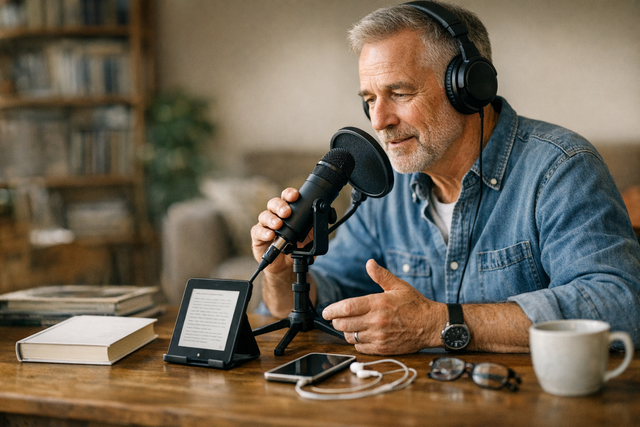
Many people carry a book inside their head, waiting to be born. A life's experience, professional expertise or a one-of-a-kind story — all the ingredients are there, but there's no time, energy or skill for the writing itself. What if you could make a book simply by speaking?
The idea sounds simple, and at its best it really is. You speak your story, AI turns it into text and shapes it into readable chapters. But then comes the question many people run into: how does a finished manuscript become a real book?
A book isn't finished until it exists in some form you can hand to someone to read. A printed book you can give as a gift. An e-book you can send by email. Or an audiobook you can listen to on a walk. In this article we'll walk through the whole journey from voice to finished book — and how to choose the right format for publishing.
This guide focuses on finishing and publishing the book. The whole journey from idea to finished book is gathered in our overview guide, writing a book about your own life.
Why speaking your book works
Speaking is faster than typing
The average person speaks around 130 words per minute, but only types 30–40 words per minute. Speaking lets you produce content three to four times faster. An hour of recording easily yields 8,000 words of text — already several chapters' worth.
The story emerges naturally
When you tell something out loud, you don't get stuck staring at a blank page. Thoughts follow one another organically, details bubble up, and the story finds its own rhythm. When you speak you're at your most authentic — and that comes through in the final text.
Anyone can speak
Writing takes practice. Speaking is a skill you've been honing your whole life. You don't need to be an author to make a book — it's enough to have a story to tell and the willingness to say it out loud.
From voice to book — step by step
1. Set up a book project
Everything begins with a book project. Give your book a title, write a short description of what it's about, and choose a narrative style. Do you want a memoir, a biography, a non-fiction work, or perhaps a free-form collection of essays? The style guides the AI to write chapters in your voice.
You can also define your audience — are you writing for family, for professionals, or for a wider readership? These choices help the AI understand what kind of language and tone the book should use.
2. Record or upload audio
Recording works straight in the browser — all you need is a microphone. Press record, speak, stop. You can listen to the recording before saving and start over if you like.
A recording isn't easily lost. Stopping doesn't save or discard it: you decide, and Vellu asks before anything is thrown away or before you leave the page with an unsaved recording. If the browser tab closes, the phone shuts the page down in the background, or the browser crashes mid-recording, the audio is kept on your device. The next time you open the book's recordings on the same phone or computer, Vellu offers to restore it.
If you already have audio files, you can upload them directly. Vellu supports all common audio formats: MP3, WAV, M4A, FLAC and others. A single file can be up to 500 megabytes — enough for hours of recording.
Each recording is one "story fragment". You can record different memories, different topics, on different days. Not everything needs to fit into one recording — the AI will weave the fragments together later.
3. Speech turns into text automatically
Once a recording is saved, the AI transcribes it automatically. Speech becomes text in minutes, accurately and reliably.
You can review the transcript and correct any errors — names, place names or dialect words the AI may not have recognised. The original transcript is always kept safe.
4. The AI analyses and summarises
Each recording gets an automatic summary: what was discussed, what the key themes were, what the emotional tone felt like, and which passages might be especially interesting for the book.
Recordings also receive automatic tags that describe their content: people, places, periods, emotions, themes. Tags make it easy to find and group recordings later when you start assembling chapters.
5. A storyline and structure take shape
When you have enough recordings, the AI analyses the whole and suggests a storyline for your book. It identifies characters, events, themes, turning points and tensions across your recordings. You can accept, reject or edit the suggestions — you decide what the story's thread really is.
The storyline updates as you add new recordings. The AI also notices gaps in the story and suggests interview questions you can use to fill in the missing pieces in your next recording.
6. Chapters come to life
Now for the moment of magic. You choose which recordings a chapter draws on — either by selecting tags or picking individual recordings — and the AI writes a finished chapter from them.
The text isn't just transcribed speech. The AI shapes the material into flowing prose that follows the narrative style you chose. It removes repetition, organises thoughts and keeps your personal voice intact.
You can watch a chapter take shape in real time as the text appears on screen. Every generation is saved to version history, so you can always go back to an earlier version.
7. Edit and polish
The AI's draft is a strong starting point, but you have the final word. In Vellu's text editor you can edit chapters freely: add details, correct names, tweak word choices.
If a whole chapter needs rewriting, you can ask the AI to redo it with different instructions or in a different style. You can also add new recordings as source material for a chapter and generate an enriched version.
Changes save automatically, and every version stays in history.
From finished text to finished book — three publishing formats
This is where many traditional writing projects stall. The text is done, but how does it become a book? Vellu offers three ways to publish your finished book — and each suits a different situation.
Printed book: hold your story in your hands
A printed book has a magic all its own. When you open a hardback and feel the paper between your fingers, it's a different experience from reading on a screen. A printed book is also a tangible gift — something you can hand to someone and say: "This is my story."
Through Vellu you can order your book in print. Choose paperback or hardback, page size and quantity. Books are produced print-on-demand, so you don't have to order stock — you can order just a single copy, delivered to you.
Who is a printed book for?
- A memoir you want to give to family members
- Family history for a family reunion
- An association or company history volume
- A book you want to put on the shelf and keep for generations
E-book: share your story digitally
The e-book is the fastest way to get your book into readable form. Vellu generates a finished e-book from all your chapters in two formats:
EPUB format is the standard that nearly every e-reader and reading app supports. You can read it on a Kindle, a Kobo, an iPad or a phone reading app. The text reflows to fit the screen, so the reading experience is always comfortable.
PDF format is familiar and universal. It looks the same on every device, and it's easy to print or send by email. Vellu's PDF book includes a cover page, a table of contents and elegantly formatted chapters.
Both formats include the book title, author name, description and all chapters in the correct order. You download the file and can share it right away — by email, on a USB stick or through a cloud service.
Who is an e-book for?
- You want to share the book quickly with family or friends
- Your readers are spread across different countries
- You want an affordable way to distribute your book widely
- The book is primarily meant to be read on a screen
Audiobook: listen to the story in the narrator's voice (coming later)
What if your story could be listened to? The audiobook is a format growing at explosive speed. People listen to audiobooks while walking, driving, in bed and at work. Audiobooks reach people in moments where reading isn't an option.
The audiobook is coming to Vellu later. You'll be able to create an audiobook with an AI voice, with several voices to choose from — both male and female — localised by language, so an English-language book sounds natural in English. You'll also be able to clone your own voice, so the audiobook sounds as though you yourself were reading it.
Think about it for a moment: you record your story in your own words, AI writes it into a book, and the end result is an audiobook that sounds like you. The circle closes — your story returns to audio, but now it's structured, polished and ready to share.
Who is an audiobook for?
- Readers who'd rather listen than read
- Older family members for whom reading is difficult
- You want to preserve the narrator's own voice (voice cloning)
- A book you want to share as easily as possible for listening
Why pick just one? Publish in every format
In traditional publishing, every format demands its own process: different layout, different production, different distribution. With Vellu, every format is generated from the same source — your book's chapters. You can publish the same book in print and as an e-book without doing any extra work — and an audiobook is coming later.
That means you can give each reader the book in the form they enjoy most:
- For children a printed book to leaf through together
- For a relative abroad an e-book by email
- For a busy friend an audiobook for the commute
- For yourself all three — because why not
What can you write by speaking?
Speaking your book into being suits many kinds of projects. Here are a few examples:
- Memoirs — Tell your own life story, childhood memories and life experiences for your children and grandchildren. You can also do it with the help of AI.
- Autobiography — Capture your whole life story in depth, from childhood to the present day.
- Biography — Write the life story of a loved one or a notable person based on interviews.
- Family history — Interview relatives and gather your family's stories between two covers.
- Elders' stories — Capture the memories of older loved ones before they fade.
- Local history — Interview long-time residents and make a book about the history of your area.
- Association history — Record the story of a club or organisation for an anniversary or for future members.
What these all share is that the material is born by speaking — either alone or by interviewing others — and the AI handles the heavy lifting: transcription, structuring and writing.
Practical tips for your book project
Start without a plan
You don't need to know what the book will be. Begin with one story, one memory, one topic. As recordings accumulate, the bigger picture comes into focus on its own — and the AI helps you find the thread.
Record in short bursts
15–30 minute recordings are ideal. They're long enough for a story to develop, but short enough that you don't tire. You can record on different days, in different places, in different moods — all of it enriches the book.
Use the AI's questions
Vellu suggests interview questions based on what you've already covered — and what you haven't. The questions help you find new angles and make sure no important topic goes untouched. You can start a recording straight from a question with a single click.
Let others read before publishing
When chapters are ready, ask someone to read them before you order the printed version. A second reader spots ambiguities, misspelled names and places that need more background.
Choose the format to match the reader
Think about who will read your book and in what setting. If you know your audience is used to physical books, the printed version is the right choice. If you want to reach as many people as possible with little fuss, an e-book works best. And if you want your story to be heard — literally — an audiobook is the answer.
A book is a legacy
A book born from your voice is more than a collection of chapters. It's evidence of what you've lived, learned and felt. It's something you can pass on — to children, grandchildren, colleagues or readers you'll never meet.
And when that book exists in print, as an e-book and as an audiobook, it's within reach for everyone. It's no longer just a file in a folder on a computer or a pile of notes in a drawer. It's a real book that someone can hold in their hands, read on a screen or listen to through headphones.
You don't need to be a writer. You don't need to know how to write. You just need to speak.
Try Vellu and turn your voice into a book — in print, digital or audio.
Frequently Asked Questions
Can a book made by speaking be as good as one written the traditional way?
Yes. Text born from speaking is often more natural and personal than text produced by writing, because the speaker's own voice and way of expressing themselves are preserved. The AI handles the language editing and structure, but the content and the story are yours — and that's exactly what makes the book unique.
How many hours of recording does one book take?
Typically 5–15 hours of recording is enough for a book of around 150–300 pages. There's no exact rule, because a lot depends on your speaking style and the depth of the topic. It's worth starting with a few short recordings and seeing how the material grows.
In which formats can the finished book be produced?
Right now you can have your finished book as a printed book delivered to you and as an e-book (EPUB and PDF), both generated from the same source — your chapters. An AI-voiced audiobook is coming later.
Do you need special equipment to speak your book?
No. A phone's voice recorder or a computer's built-in microphone is perfectly enough. The main thing is to record in a quiet space and to speak clearly enough. Vellu's browser-based recording works straight away, with no extra apps.
Does speaking a book work for every kind of book?
Speaking your book works especially well for story-based books: memoirs, family histories, interview-based books and expert books. It may not suit technical manuals or scientific publications, but for anything where the naturalness of narration is a strength, speaking is an excellent choice.