Writing a Biography — A Guide to Capturing Another Person's Story
29 March 2026
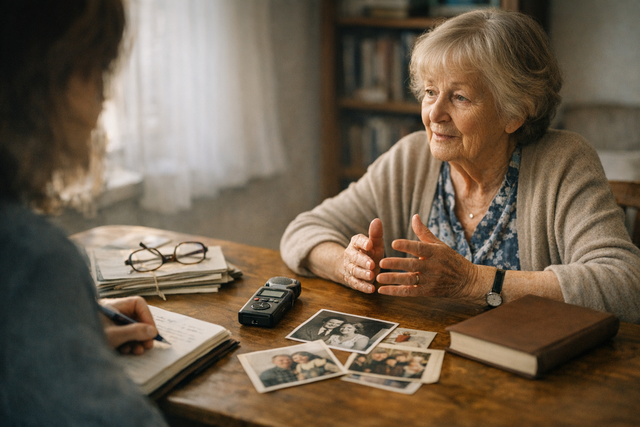
There is a story in every person's life that deserves to be told. Sometimes that story is so meaningful that someone else wants to write it — a child about a parent, a grandchild about a grandparent, or a non-fiction author about someone whose life's work has touched many.
Writing a biography is one of the most demanding but rewarding book projects. Unlike memoirs, where you tell your own story in your own words, a biography involves interpreting another person's life — and that brings its own challenges and opportunities.
In this guide we walk through how to write a biography step by step: from background research to interviews, from structure to final polish.
If your subject is still living, the project has a particular shape of its own — consent, the right of review, whose voice the book is in, and what to do when they remember things differently than you do. We've covered that case separately in how to write a biography about someone else.
A biography is one way to preserve a human life as a book. For the whole picture of the different forms and the full process, see our overview guide, writing a book about your own life, which gathers all the articles on the subject in one place.
Biography, autobiography or memoir — what's the difference?
Before you begin, it helps to understand the differences between these forms:
- Biography is an account of a person's life written by someone else. The author researches, interviews and interprets the subject's life story.
- Autobiography is a comprehensive account of a person's life written by the subject themselves.
- Memoir is a more flexible genre in which the author shares selected memories and experiences — often thematically rather than covering an entire life.
A biography typically aims for completeness and objectivity. It is not just a collection of stories but a structured whole that places a person's life in a wider context.
These and the other terms of book-making — transcription, typesetting, print on demand, self-publishing — are explained briefly in our glossary.
Who biography writing suits
Family members
The most common reason to write a biography is the wish to capture a loved one's story. A father's wartime experiences, a mother's career abroad, a grandfather's journey from countryside to city — these are stories that disappear unless someone writes them down.
Community historians
Writing local history or an association's history often involves biographical sections. The stories of notable individuals give history a human face and make it more vivid than a mere list of events.
Professional writers
Biographies are a literary genre with a long tradition. If your interest is in bringing someone else's story to a wide audience, biography is the right form.
Background research — the foundation matters
Gather the facts first
Writing a biography starts with research. Before your first interview, collect all the factual information available:
- Birth, marriage and death certificates — the basic timeline
- Photographs — putting them in chronological order helps map out life stages
- Letters, diaries, notebooks — first-hand source material
- Press clippings, publications — outside perspectives
- Official documents — employment records, school certificates, military papers
This groundwork helps you build a timeline onto which you can later attach the stories that emerge in interviews.
Study the era
A biography is not just an individual's story — it is also the story of an era. If you are writing about someone born in the 1940s, you need to understand what life was like then: post-war Europe, reconstruction, rural-to-urban migration, industrialisation. The historical context gives the biography greater depth.
Map the network of people
Who else was in the subject's life? Beyond family, colleagues, friends, neighbours and mentors can offer perspectives the subject would not share — or might not even remember.
Interviews — the heart of a biography
Prepare carefully
A good interview is not a casual chat. Prepare your questions in advance, but be ready to deviate from the plan when interesting paths open up. Good preparation means:
- A timeline in front of you — so you know which life stages you want to cover
- Open questions — "Tell me about…" and "What was it like…" yield richer answers than "Was that nice?"
- Contradictions flagged — if different sources give different accounts, the interview is a chance to clarify
Record everything
This may be the single most important piece of advice: record every interview. Relying on notes inevitably leads to lost information. With a recording you can go back and check the exact wording, the mood, and the details you didn't write down.
Recording is easy these days — a phone's voice recorder is enough. A dedicated recorder is more reliable for longer interviews. Always ask permission to record and explain how the material will be used.
A framework of interview questions
A good interview framework moves chronologically but leaves room for digressions:
Childhood and youth:
- What was your family like? Tell me about your parents and siblings.
- What was everyday life like at home? What did you eat, what did you do in the evenings?
- What is your earliest memory?
- What was school like? Did you have a favourite subject?
Adulthood:
- How did you end up in your current profession?
- Tell me about your relationship — how did you meet?
- What were the biggest decisions of your life?
- What has been the hardest time in your life?
The present and reflection:
- What have you learnt about life?
- What are you proud of?
- What would you do differently?
- What would you like future generations to know?
Multiple interview sessions
One interview is not enough. Putting together a biography typically requires 5–15 interview sessions, each lasting 1–2 hours. The first sessions create an overview; later ones deepen and fill in the gaps.
Leave time between interviews — both for you to digest the material and for the subject to reflect. Often the best memories surface in the gaps between sessions.
The structure of a biography
A biography is built from a standard set of parts — an opening scene, roots and background, early life, education, working life, family, turning points, later years, a closing — and you arrange them using one of a few established models. The three below are the most common; our guide to how to structure a biography covers all five, along with the parts in detail and how much of the book each one should take.
Chronological structure
The most common and natural approach is to move from birth to the present. A chronological structure is easy for the reader to follow and gives a clear picture of a life's arc. Chapters can be divided by decade or by life stage:
- Childhood and family background
- School and youth
- Studies and choice of profession
- Work and career
- Family life
- Maturity and legacy
Thematic structure
If the subject's life has clear themes — career, family and a passion, for example — you can devote a section to each. This works especially well when you want to explore certain areas of life in depth.
Open with a hook
A good biography does not begin with a date of birth. Open with a scene that draws the reader in: a decisive moment, a dramatic turning point, or a touching image. After that you can return to chronological storytelling.
The ethics of writing a biography
Truth and interpretation
A biographer inevitably makes interpretations. You choose what to include and what to leave out, how to weigh events, and what overall picture to build. That is a great responsibility.
Be honest with the reader: separate facts from your own interpretations. If you don't know something for certain, say so. If different sources tell different stories, mention it.
Respecting privacy
A biography inevitably tells the story of other people too — a spouse, children, colleagues. Think carefully about what you write about others, especially on sensitive matters. A good practice is to let the people mentioned read the relevant passages before publication.
The subject's own voice
Even though you are writing the biography, try to preserve the subject's own voice. Use direct quotations from the interviews. Let the reader hear how the subject speaks, thinks and feels.
AI as a help in writing a biography
A biography requires a great deal of interview material, and processing it has traditionally been heavy work. AI can help significantly:
Transcribing interviews
Dozens of hours of recordings can be transcribed by AI in minutes. This saves an enormous amount of time and makes it easy to return to the original material.
Organising the material
When there are many recordings, AI helps to identify themes, people and connections across time periods. It sees the whole picture that can be hard for a person to spot among dozens of hours of interviews.
Generating the text
AI can turn interview material into flowing prose that preserves the interviewee's own voice. This is especially helpful when you are writing a biography of a loved one and you are not a professional writer.
Tools such as Vellu.ai combine all of these steps: you record the interviews, AI transcribes and analyses them, and finally generates draft chapters. Read more about writing memoirs with AI.
Practical tips for the biographer
- Start by building a timeline. Before you write a single word, make a chronological list of the most important events in the subject's life. It is your map.
- Don't rely on a single source. Interview several people, check facts against documents, and look for contradictions — they are often the most interesting passages.
- Write scenes, not summaries. "She moved to the capital" is dull. "She stepped off the train at the central station in September 1968, a single suitcase in her hand" is biography.
- Let the subject speak. Use direct quotations generously. They bring life and authenticity to the text.
- Write about failures, too. A biography that only tells of success is not credible. Difficulties, failures and uncertainty are what make the story human.
A biography is a gift
Writing a biography is a demanding project, but the result is priceless. You have captured a person's life story — their experiences, insights, joys and sorrows — in a form that will endure for generations.
A biography is not just about preserving the past. It is about building family history, strengthening a family's identity and honouring human experience.
Whether you are writing the biography of your father, your teacher or a notable figure in your community — start today. Every interview, every recording, every captured memory is a step toward a finished book.
Someone's story is waiting for its teller. Perhaps that teller is you.
Frequently Asked Questions
How long does it take to write a biography?
That depends on the scope and your way of working. With traditional writing, putting together a biography typically takes 6–18 months. With AI assistance the process can be compressed to a few months, because transcription, organising the material and generating text speed up considerably.
Does the subject of a biography have to be a famous person?
Absolutely not. Every person's life story is valuable. Most biographies are written about ordinary people — parents, grandparents, influential figures in a community — whose story is meant to be preserved for the family and future generations.
How do I get the interviewee to speak openly?
Trust is built over time. Start with lighter topics — childhood memories, descriptions of everyday life — before moving to harder themes. Listen actively, don't interrupt, and show genuine interest. Openness often grows over successive interview sessions.
Can a biography be written about someone who has already passed away?
Yes. Many significant biographies have been written after the subject's death. In that case the material is gathered from others' memories, archives, letters and documents. Those interviewed are the person's family members, friends and colleagues.
Do you need the subject's permission to write a biography?
If the subject is alive, their consent is essential both ethically and practically — you need their cooperation for interviews. If the subject has passed away, permission is not legally required, but it is good practice to consult close relatives and respect their wishes.