Association History as a Book — A Guide to Capturing Your Society's Story
20 March 2026
Across Europe, hundreds of thousands of associations, clubs and societies are active. Sports clubs, volunteer fire brigades, women's groups, hunting societies, choirs, youth associations, veterans' associations — each one has a story spanning decades. But how many of those stories have been written down?
The history of most associations lives only in the memories of active members and in old minute books. When long-standing members step back from activity, the stories that make the association unique disappear with them — the moments that never appear in any official document.
Capturing your association's history as a book is a valuable act that strengthens the community and honours the contribution of everyone who has worked for it.
An association's history is one way to preserve a shared story as a book. For a broader overview of making a book, see our overview guide, writing a book about your own life.
Why it is worth recording your association's history
Anniversaries deserve a book
Many associations only think of recording their history as an anniversary approaches — a 50th, 75th or 100th anniversary. A history book is a wonderful way to mark the journey, but making one takes time. Starting early helps you avoid a last-minute rush.
Stories disappear
An association's founders and early activists are not with us forever. Their personal memories — why the association was founded, what challenges were faced, how the first events were organised — are irreplaceable. These stories are not in the minutes.
New members need roots
When a new member joins, it matters that they understand what they are joining. A history book helps new members feel they are becoming part of something bigger and worthwhile.
Pride in the community
Once an association's story is in print as a book, members value their own work more highly. It reminds them of everything that has been achieved together and motivates them to keep going.
What an association history book can contain
A history book does not have to be a dry list of events and chairpersons. At its best, it combines:
- The founding story — Why and how did the association come about? Who set it in motion? What was the need or enthusiasm that started it all?
- Profiles — Who were the key figures? What kind of personalities were they? What motivated them?
- Turning points — Which events shaped the association's direction? Were there crises, successes, surprises?
- Everyday life and celebrations — How has the activity shown up in everyday life? What kinds of events and celebrations have been organised?
- Changes — How has the activity changed over the decades? What is done differently now?
- Moods and memories — Amusing incidents, moving moments, descriptions of the spirit of the group
The best association histories tell the story of people, not just of organisational structures.
Mapping out source material
Before starting the interviews, it is worth finding out what material the association already holds. There is often surprisingly much.
Minutes and annual reports
Minutes are the backbone of an association's history. They tell you what was decided, but not what actually happened. They are nonetheless irreplaceable for checking facts: when the association was founded, who served on the board, what decisions were taken.
Tips for using minute books:
- Build a timeline from the minutes — the most important events and decisions year by year
- Identify turning points: when membership grew or shrank, when new activities began
- Look for names — who has been most active and longest involved
Photographs and press clippings
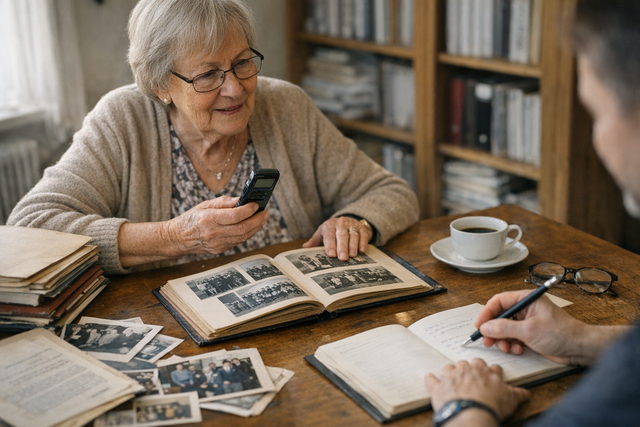
Many associations have a photo archive that has grown over the decades. Press clippings may have been kept in a folder or a scrapbook. These are visual material for the book, but also prompts for interviews — show old pictures to the interviewee and ask: "What do you remember about this?"
Other materials
- Member lists from different years
- Programmes and posters from events
- Awards, medals, recognitions
- Letters, invitations, meeting announcements
- Song booklets, competition results, trip reports
Interviews — gathering the stories
Interviews are the most important phase of the project. The minutes tell the facts, but the interviews tell the story.
Whom to interview
- Long-standing members — they know the arc of the association
- Former chairpersons — they have an overall view from different eras
- Founding members or their family members — keepers of the founding story
- Coaches, leaders, conductors — those who have been at the heart of the activity
- Younger members — a fresher perspective and a point of comparison
Good interview questions for association history
- "How did you come to join the association? Who encouraged you?"
- "What was the spirit of the association like then? How was it different from today?"
- "What is the best thing you have experienced through the association?"
- "Was there a particular event, competition or occasion that was especially significant?"
- "How has the activity changed during your time?"
- "Was there a crisis or a difficult period? How was it overcome?"
- "What is your funniest memory of the association?"
- "Who has been the most important person in the association's history? Why?"
- "What would you say to future members?"
Interview practices
- Arrange the interview in advance and explain what it is about
- Reserve a quiet space and enough time (30–60 minutes)
- Start with general questions and let the interviewee talk freely
- Record the whole conversation — the best stories come spontaneously
- Use old photographs and minute books as conversation starters
Building a timeline
The timeline is the backbone of an association history book. It helps you organise decades of events and find the book's structure.
How to build the timeline:
- Work through the minutes and annual reports year by year
- Note: founding, changes of chairperson, major events, changes in membership, new forms of activity, achievements
- Add events that emerge from the interviews
- Identify natural periods: the early years, the years of growth, consolidation, renewal
The timeline also helps you spot which periods still need more material.
Structural options for the book
Chronological
The book moves in time order, from founding to the present. The clearest and most traditional structure, especially well suited to anniversary publications.
Thematic
Chapters cover different themes: competition, training, finances, premises, celebrations, community. Suitable for associations whose activity is wide-ranging.
Person-led
Each chapter tells the story of one key figure and their role in the association's history. Makes the book human and approachable.
Combined
Often the best solution is a combination: a chronological backbone with profiles and deeper thematic sections woven in. For example, a chronological narrative with side panels: "Do you remember this?" or "Who was…?"
Examples of association history projects
A sports club
A football club is turning 75. Former players, coaches and board members from different decades are interviewed. The book tells the club's story from founding to today, from building the pitch to championship celebrations and the moments that have created the club's spirit.
A volunteer fire brigade
A volunteer fire brigade has been operating for more than a hundred years. The history book describes how it was founded, what firefighting was like before modern equipment, how training has changed and what the brigade means to the local community.
A women's community group
A local women's community group brings together stories from decades of activity: courses, outings, cooperation with the school, support work during difficult times. The book describes the importance of women's work in the local community.
A choir or musical society
A choir's history is full of concerts, festivals, sing-alongs and tours. The interviewees' memories reveal the meaning of music for the community and for individuals.
Involving members
An association history book is at its best as a communal project. The more members take part, the richer the book becomes.
Ways to involve members:
- Memory evenings — organise an occasion where members can share memories aloud. Record everything.
- Photo collection — ask members to bring old photographs to be scanned.
- Written survey — send members a short questionnaire: "What is your best memory of the association?"
- Social media — share old photographs on the association's social channels and invite comments.
- Review round — let the finished text circulate among active members before publication.
Involvement doesn't just improve the book's content — it builds community already during the project.
Budgeting and publication
Costs
The biggest costs of an association history book have traditionally been transcription, writing and layout. AI tools such as Vellu.ai can significantly reduce this — transcribing recordings and drafting chapters is handled with AI, allowing the working group to focus on interviews and final polish.
Printing costs depend on the print run. Print-on-demand services make even a small print run possible without large upfront investment.
Funding
Funding can be sought from the association's own funds, municipal cultural grants or donations from members. For some associations the anniversary budget covers the cost of the history book.
Publication formats
- Printed book — the most traditional and prestigious form, especially suited to anniversaries
- Digital publication (PDF) — easy to share with all members
- Online publication — can be published on the association's website
An association's history book is part of a wider effort to write local history — a society's story always tells part of its area's story too. And on research methods, the guidance for recording family history offers useful tips for working with archive material.
Start now — don't wait for an anniversary
The best time to start recording your association's history is right now. Don't wait for the next milestone year — by then there may be fewer interviewees left. Start with a single interview, record the story of one long-standing member, and see how easily text emerges from it.
Capture your association's story — start with a single interview and let the history speak for itself.
Frequently Asked Questions
Who in the association should lead the history book project?
Often the best option is to set up a small working group (2–4 people) that includes both a long-standing member who knows the history and a technically able person who handles recording and text. A single coordinator is needed to steer the project.
How long does it take to make an association history book?
With an active working group, a book can be completed in 3–6 months. Most of the time goes into arranging and carrying out interviews. AI tools speed up the transcription and drafting phases considerably. Don't let a long timeline put you off starting — every interview that gets recorded is valuable, even if the book itself is finished later.
Where do I find material on the association's history?
Start with the association's own archive: minutes, annual reports, photographs, press clippings and correspondence. Complement this with interviews — long-standing members remember events that don't appear in any document. The municipal archive and the local newspaper's archive can also provide valuable background material.
How much does an association history book cost to produce?
Costs vary considerably with the scope of the project. The biggest savings come from using AI tools for transcription and drafting. Printing is often the largest single cost — print-on-demand services make even a small print run affordable. Funding can be sought from the association's funds, municipal cultural grants or membership fees.