Recording Elders' Stories — How to Interview and Turn Their Memories Into a Book
20 March 2026
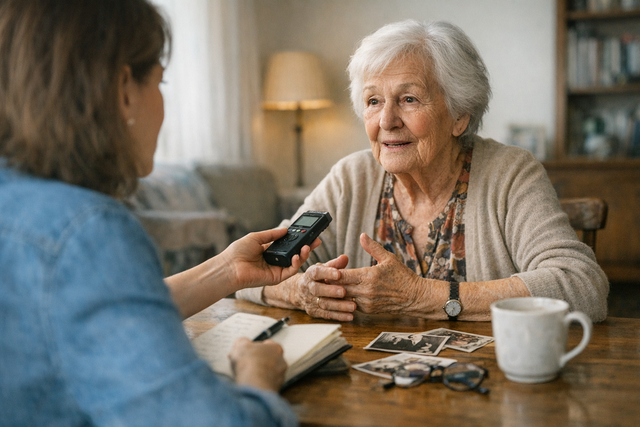
Your grandfather has hundreds of stories you have never heard. Your grandmother remembers things no one else knows. Your parents have experiences that would change how you understand your own history. These stories exist right now — but not forever.
Many of us wake up too late to how much knowledge and how many stories we lost because we didn't ask in time. "I wish I had asked more" is one of the most common late-in-life regrets.
This article is a practical guide for anyone who wants to record an older relative's stories before they're gone. You don't need special skills, expensive equipment or vast amounts of time — just a phone and genuine interest.
Recording elders' stories is one way to turn a life into a book. Our overview guide, writing a book about your own life, gathers all the starting points and the whole process in one place.
Why you are the right person to do this
You have their trust
Older people share their stories most readily with those they trust. As a family member, you already have a natural bond of trust that no interviewer training can replace. Your grandfather will tell you things he would never tell a stranger doing research.
You know what to ask
You know your family's history and its gaps. You know which subjects have never been talked about, which stories have been left half-told, and what you would like to understand better.
The time is now
Every day is an opportunity. Memory fades, health changes, and life is unpredictable. Starting today is always better than starting tomorrow.
The psychology of an interview — how to create a safe space
A good interview isn't just a matter of asking questions. It is an encounter in which the person you're interviewing feels respected and safe. These principles help.
Respect is the foundation of everything
Older people are quick to sense whether interest is genuine. When you approach the interview with humility — "I want to learn from you" — you create a space in which telling their story feels meaningful.
Memories aren't facts
Personal memory is always subjective. Dates can be wrong, events can blur into one another, details can shift. That's normal. Don't correct or challenge — every memory is valuable as it is. The teller's experience is always "right", even if the facts differ from what the archives say.
Give them time
Older people often tell stories more slowly and more reflectively than younger ones. This isn't a weakness, it is a strength — considered telling produces deeper stories. Don't rush. The best approach is to set aside plenty of time and let the conversation move at its own pace.
A practical guide: how to interview an older relative
Before the interview
Choose the right moment. Older people are often at their brightest in the morning or early afternoon. Avoid times when they are tired or have somewhere to be.
Tell them in advance what this is about. Don't surprise them with a recording. Say something like: "I would like to hear your stories and record them, so that the children can listen to them one day too. Would that be all right?"
Most older people are delighted when someone takes an interest in their life. For many of them it feels like a mark of respect.
Prepare a few opening questions. You don't need to plan the whole interview, but a handful of good opening questions will help you get going.
During the interview
Start with easy topics. Don't jump straight into difficult or emotional themes. Begin with concrete, happy memories:
- "Tell me about your childhood home — what was it like?"
- "What did you do for fun as a child?"
- "What was school like for you?"
Listen more than you talk. The most important skill an interviewer has is listening. Let your relative speak at their own pace, and don't interrupt even if the story wanders. The side roads are often the best parts of the story.
Ask open questions. "What was life like back then?" is a better question than "Was life hard?" Open questions give space for the teller's own perspective.
Ask about the senses. "What did it smell like there?" "What sounds do you remember?" "What did it feel like in your hands?" Sensory questions awaken memories that ordinary questions miss, and they make the stories come alive.
Allow silence. When your interviewee falls quiet, don't fill the pause with another question. The deepest memories often surface after a silence.
Use photographs. Bring along old family photos. They are a magical way to unlock memories. "Who is this? Where was it taken? What do you remember about that day?"
The technical side — keep it simple
Recording is easy these days:
- A phone is enough. Use your phone's voice recorder app (every phone has one).
- Place the phone close. Set the phone on the table between you and your relative. Keep it about 30–50 cm from the speaker.
- Do a test recording. Record 30 seconds and listen back — can you hear the speech clearly?
- Look after the battery. Charge the phone before the interview.
- Better to record too much than too little. You can always leave something out, but you can't add something that wasn't recorded.
After the interview
Thank them and show appreciation. Tell them how valuable this has been. Promise that the stories will be preserved.
Make notes. As soon as the interview ends, jot down your thoughts: what surprised you, what you would like to ask more about next time, which stories were especially moving.
Arrange the next session. One interview often awakens new memories. Schedule another meeting a week or two later — in the meantime your relative will often have remembered a great deal more.
What to ask — a question bank
Childhood and youth
- "What was your childhood home like? Describe it to me."
- "What sorts of games did you play?"
- "What was school like? How did you get there?"
- "What did you eat on an ordinary weekday?"
- "What was the best thing about your childhood?"
Family and relationships
- "Tell me about your parents — what kind of people were they?"
- "How did you meet your partner?"
- "What was it like when your first child was born?"
- "Who have you learned most from in your life?"
Work and daily life
- "What was your first job?"
- "How did daily life work when the children were small?"
- "What was the best thing about your work? And the most challenging?"
- "How has daily life changed during your lifetime?"
Historical events
- "What do you remember about wartime?" (or the post-war years)
- "How did difficult times affect your family?"
- "How has the world changed during your lifetime?"
- "What is the biggest change you have seen?"
Values and wisdom
- "What is the most important lesson life has taught you?"
- "What would you like your grandchildren to remember about you?"
- "Is there something you regret, or something you are especially proud of?"
- "What advice would you give your younger self?"
Special situations and how to handle them
When memory is already fading
If your relative's memory has started to fade, act quickly but gently:
- Focus on long-term memories — they often last the longest
- Keep sessions short (15–20 minutes)
- Don't correct or challenge memories
- Use plenty of photographs and familiar objects to trigger memories
- Value every story — even an incomplete memory is precious
- Accept that some days are better than others — try again on another day
When the topics are difficult
War experiences, losses, family conflicts — not everyone wants to talk about everything. Respect the boundaries:
- Don't push if your relative doesn't want to talk about something
- Offer the chance: "Would you like to tell me about this? You don't have to."
- Remember that the point of the interview is to record what the interviewee wants to tell
- If a difficult subject comes up, listen calmly and give space for the feelings
- Sometimes hard topics only come up at the second or third session, once trust has grown
Remote interviews
If your relative lives far away, the interview can also work by phone or video call. The quality won't match a face-to-face meeting, but a less-than-perfect recording is still better than none at all. Ask a relative who is with them to put the phone close and help with the technology.
When you interview several family members
If you interview, say, both of your grandparents, you will get different perspectives on the same events. That's a richness, not a problem. The book can include both versions — which makes it multi-voiced and authentic.
Ethical principles
Recording another person's stories comes with responsibility. Keep these principles in mind:
- Consent. Always ask permission before recording, and explain how the recordings will be used.
- Respect. The interviewee decides what to share and what not to share. Don't push.
- Privacy. Some stories are told in confidence. Before publishing, ask which things can be shared more widely.
- Acknowledgement. It's good to credit who told which story in the book. It's a mark of respect.
A book as a gift
A finished book is an extraordinary gift:
- For the interviewee themselves — their story has been valued and preserved
- For the family — each member can have their own copy
- For future generations — your grandchildren will be able to read their great-grandparent's story decades from now
Many people say a book like this is the most valuable gift they have ever received. And if your interviewee would like to write their own memoir — not just as an interview but in their own voice — there are ways to do that too. Read more about writing memoirs.
Interview recordings are also valuable material for a broader family history — a single interview project can grow into the story of an entire family.
Start today — one phone call is enough
You don't need to plan for months. Call your relative or pay them a visit and say: "I'd like to hear your stories." Set your phone to record and let the conversation flow.
Even one recording is better than none. And once you've done it, the threshold for carrying on is much lower.
Record your loved ones' stories before they disappear. One phone call can save decades of memory.
Frequently Asked Questions
How do I get an older relative interested in being interviewed?
Many older people will say at first that "there's nothing special about my life". Don't give up — tell them that you want to hear their story in particular. Start gently: "Tell me about your childhood", or "What was school like in your day?" Old photographs are an excellent conversation opener. Once the interview gets going, most people warm to telling their story.
How long should an interview session be?
The ideal session lasts 20–45 minutes. An interview that's too long tires the teller and the quality of the stories suffers. Better to do several short sessions than one long one. After the first session, your relative often remembers more, and is even more ready for the second.
Can the interview be done remotely?
Yes. A phone call or video call works if meeting face to face isn't possible. Ask a relative who is with them to place the device close to the speaker. Sound quality matters most — a quiet room and putting the phone close to the speaker really helps.
What do I do if my relative's memory is already fading?
Act quickly but gently. Focus on long-term memories, which often last the longest. Keep sessions short, use photographs and familiar objects to trigger memories, and don't correct mistakes. Even a fragmentary memory is a valuable record.
Do I need the interviewee's consent to record?
Yes, always ask for permission before you start recording. Explain clearly how the recording will be used and who will see or hear it. Respect the interviewee if they want to leave something out or don't want a certain thing to end up in the book.