Can You Write a Book with ChatGPT? Yes — But a Book Is More Than Text
19 July 2026
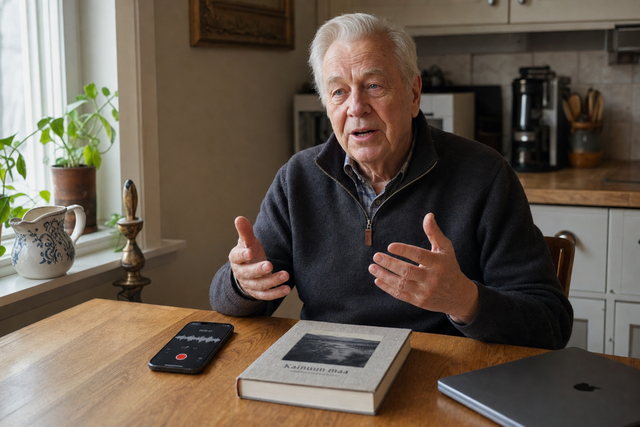
Yes, you can. ChatGPT and other AI chatbots such as Claude and Gemini write fluent text and are genuinely helpful for brainstorming, outlining and polishing. But a whole book is more than text: it is dozens of stories that need to be captured, organised, written into chapters and finally bound between covers. That is where a general-purpose chat tool runs out — and exactly what Vellu.ai is built for, powered by the same AI.
This article is an honest comparison: where ChatGPT serves a book project well, where it falls short, and what a purpose-built book tool does differently. The question is not which AI is smarter — under the hood the technology is largely the same — but everything that has to happen around the text before you are holding a book.
If you are still weighing up how to record your own life as a book at all, our main guide to writing a book about your life gives the full picture.
What is ChatGPT good for in a book project?
ChatGPT is genuinely useful in the early stages of a book: narrowing the topic, thinking through chapter order, coming up with titles, polishing a paragraph. It is a patient sparring partner that never tires of your questions. If you are writing your book yourself and want a helper for thinking and language, a chatbot serves that need well.
This is worth saying plainly, because people are needlessly shy about using AI in book-making. Using a tool does not make the book any less yours — we've written a separate honest piece on AI and creative writing.
Where does a chatbot fall short?
A chatbot falls short at the point where your stories start adding up to a book. A book is not made in one sitting but over weeks and months, as dozens of separate memories — and a chat is one long scroll where earlier stories get buried under new ones. Even though the newest chatbots remember things across conversations, they are not an archive: there is no view that shows which stories you have already told, what is missing, and which chapter each one belongs to.
A tool built for making books approaches this from the other direction. In Vellu, every recording lands in the book project's own library, AI writes a summary of it and picks out the story elements — people, events, places and themes — and events fall into place on a timeline. Chapters are written from the recordings you select, and AI suggests interview questions that fill the gaps in your story. You can ask a chatbot to interview you too, but its questions aren't grounded in everything you have already told the same way.
Whose words does the book come from?
Many people have tried typing to a chatbot: "Write a book about my life." The result is fluent text — but somehow about someone else's life. A chatbot fills the gaps with plausible-sounding material you never said. In a novel that can be a feature; in a memoir it is a defect: an invented detail is a mis-remembered life.
In Vellu, the book is built from the memories you actually told. Your speech is turned into text as spoken, and chapters are written only from that material: the AI shapes spoken narration into fluent book prose, but does not invent content beyond it. Your word choices, your way of telling and your perspective survive. This matters for copyright too — a book that grows out of your own narration stands on firmer ground than text a machine produced freely. More on that in who owns a book written with AI.
Can't you already talk to ChatGPT?
You can — chatbots now hold spoken conversations, and they do it well. But conversing and recording are different things. In a voice chat the AI answers back, asks questions and rephrases what it heard in its own words, and your original telling isn't preserved anywhere as such. And nobody tells a half-hour story about their childhood home as a turn-by-turn dialogue.
In Vellu you press record and tell the story in peace, at your own pace, for as long as it takes — or upload recordings you've made with your phone's voice memo app. The original audio is kept. Recording and the AI summaries are free; turning speech into text costs one credit per minute — credits are Vellu's in-app currency, and signing up comes with 100 of them free.
How does text become a finished book?
ChatGPT's end product is text on a screen. From there it is still a long way to a book: the text must be laid out, pages numbered, a table of contents built, a cover designed, the book printed. These are exactly the stages where self-made book projects have traditionally stalled.
In Vellu the finished book comes straight from the service: as a printed book delivered to your door in softcover or hardcover, as an e-book, or as a Word file for further editing — with an audiobook coming later. You can design the cover yourself in the cover tool or use the automatically typeset one, and preview the whole book as a PDF before ordering. There's a dedicated guide to the printed book: how to create your own printed book. And we've broken down the full cost of a book project in how much does it cost to make your own book.
The same AI under the hood — so what actually differs?
Vellu doesn't compete against AI; it uses it. The chapters are written by Anthropic's Claude — the same AI you can chat with directly — and speech is turned into text by OpenAI's speech recognition. The difference is not in the intelligence but in everything around it:
- A chatbot is a conversation: one scroll of text whose organisation and memory are left to you.
- Vellu is a book project: recordings, transcripts, summaries, story elements, a timeline, chapters with version history, proofreading, a cover and printing in one place.
The choice is not "AI or no AI". It is a general-purpose tool versus a workflow built for one job — the same difference as between a spreadsheet and an accounting program. You can do the books in either, but one was made for it.
Trying it costs nothing: signing up gives you 100 credits to record your first stories and see what your own telling looks like as a book chapter.
Frequently Asked Questions
Can ChatGPT write a whole book?
It can, and some people have done it. In practice the work demands a lot of self-management: collecting the text out of conversations, holding the structure together yourself, and handling layout, cover and printing with other tools. For a short text ChatGPT is plenty; over a book-length project, it's the administration that wears most people down.
ChatGPT is free — why would I pay for Vellu?
The basic chatbot tiers are free, and starting with Vellu is free too: signing up gives you 100 credits. You pay only for what a chatbot doesn't do — turning speech into text, writing chapters from the material you told, and the finished printed book. The full breakdown is in how much does it cost to make your own book.
I've already written text with ChatGPT — can I continue in Vellu?
Yes. You can paste finished text into Vellu's chapter editor and carry on from there. Often the result is even better if you tell the same stories again aloud in your own words — spoken narration brings back the detail and personal voice that chatbot-shaped text tends to lose.
Does Vellu use the same AI as ChatGPT?
The same class of technology: Vellu's chapters are written by Anthropic's Claude, a large language model like the one behind ChatGPT, and speech recognition is ElevenLabs' Scribe. The difference isn't the AI but the workflow built around it — the recording library, the story structure, and the fact that the end result is a finished book.
Who owns the copyright of a book made with ChatGPT or Vellu?
Copyright requires human creative input. When the book is based on your own narration — your own memories, word choices and perspectives — your input is strong. Text produced entirely by a machine stands on weaker ground. We've put together a plain-language guide: the copyright of a book written with AI.
What about Claude or Gemini — does the same apply?
It does. Claude, Gemini and other general chatbots are in the same position in a book project as ChatGPT: excellent for brainstorming and polishing, but the conversation format is no substitute for a library, a structure and a route to publication. The comparison in this article applies to all of them.