How to Structure a Biography — The Parts of a Life Story and 5 Models
2 June 2026
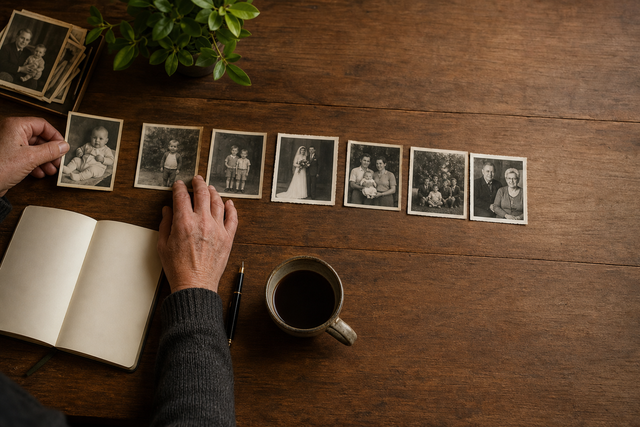
A biography is built from the same handful of parts in almost every case: an opening scene, roots and family background, early life, education and coming of age, working life, family and relationships, turning points, later years, and a closing reflection. Around that skeleton you pick one of five structures — chronological, thematic, episodic, frame story, or a hook opening followed by chronology. Chronological is the safest starting point, and it suits a whole life arc best.
Most people writing a life story hit the same wall. They have plenty of memories, no shortage of stories, and all the enthusiasm in the world — but the moment they have to decide what order to tell it all in, the whole project stalls. Where do you start? Do you go from childhood to the present? Should things be grouped by topic? And what if a life doesn't fit neatly onto a single timeline?
This is the question of structure, and it's one of the most important decisions in the entire book. Good structure carries the reader from beginning to end and turns even scattered memories into a coherent whole. Poor structure — or no structure at all — turns even fascinating stories into a confusing list.
The good news is that you don't have to invent a structure from scratch. Life stories have been written for centuries, and there are a handful of established ways to organise them. In this guide we'll walk through the five most common, explain who each one suits, and help you choose the best fit for your own story.
Structure is one part of a bigger whole. If you're looking for an overview of the entire process, read our overview guide, writing a book about your own life, which gathers all the stages of writing a life story in one place.
What are the parts of a biography?
A biography is usually assembled from nine parts, plus front and back matter. Not every book needs all of them, and the order can be rearranged — but if a life story feels like it's missing something, it is almost always one of these.
| Part | What it covers | Share of the book |
|---|---|---|
| Front matter | Title page, dedication, contents | 1–3 pages |
| Opening scene | One decisive moment that pulls the reader in | 2–5 pages |
| Roots and background | Parents, grandparents, place of origin, the era | 5–10 % |
| Early life | Childhood, home, first memories | 10–15 % |
| Education and coming of age | School, studies, the first choices made alone | 10–15 % |
| Working life and vocation | Career, craft, calling, achievements | 15–25 % |
| Family and relationships | Partner, children, friendships, home | 15–20 % |
| Turning points | Losses, illnesses, moves, wars, upheavals | 10–20 % |
| Later years and reflection | The present day, what it all added up to | 10–15 % |
| Closing | The insight or image the book leaves behind | 2–5 pages |
| Back matter | Photographs, timeline, family tree, sources | 5–15 pages |
The percentages are a rule of thumb, not a rule. The commonest imbalance in a first biography is a childhood that swallows half the book while forty years of adult life get three chapters — the table is mostly there as a check against that.
Front and back matter are easy to forget and disproportionately valuable. A one-page timeline at the back lets a reader place any chapter at a glance, and a family tree spares you from explaining who everyone is inside the story itself.
What comes after early life in a biography?
After early life comes education and coming of age — school, studies, apprenticeship, military service — and then entry into working life and the founding of the subject's own family. The through-line that matters is the handover: childhood is a life shaped by other people's decisions, and everything after it is shaped by the subject's own. Make that shift visible, and the rest of the book has a spine.
In practice this means the chapter after childhood should contain a choice: a school left, a trade taken up, a move to a city, a person met. If the years between roughly 15 and 25 read as a list of dates, the reader loses the person just as they were becoming themselves.
Biography, autobiography, or memoir — which form are you writing?
Structure depends a little on what you're writing, so here are the three closely related forms:
- A biography tells someone else's life. The writer researches and interprets the subject from the outside, so the structure often needs to be more organised and comprehensive.
- An autobiography is your own life story in full, usually from childhood to the present. Here a chronological structure is the most natural starting point.
- Memoirs are a freer form: selected memories and themes rather than the whole life arc. In memoirs, thematic and episodic structures come into their own.
The lines aren't sharp, and many books blend features of all three. The main thing is to recognise whether you're aiming to cover an entire life arc or selected pieces of it — that, more than anything, guides the choice of structure.
How do you structure a biography? Five models
1. Chronological structure
This is the most common and most natural model: the story runs from birth to the present, stage by stage. It's easy for the reader to follow, and easy for the writer to keep track of what has already been told and what's still missing.
A typical chapter breakdown might be:
- Roots and family background
- Childhood
- School years and youth
- Studies and choosing a path
- Work and career
- Family life
- Maturity, life lessons, and the present day
Suits especially: an autobiography or a comprehensive biography, and anyone writing their first book. Chronological is the safest choice if you're unsure.
Watch out for: balance. A very common mistake is to spend half the book on childhood and then race through adulthood in a few chapters. Give each stage of life the space it deserves.
2. Thematic structure
Instead of chronology, the story is divided by topic: one part on work and career, another on family, a third on a passion or life's calling. Within each theme you can move freely through time.
Suits especially: people whose lives have distinct, separate threads, and memoirs that want to explore a few topics in depth. It also works well when a life doesn't bend into a tidy timeline.
Watch out for: repetition and confusion. When the same period crops up in several themes, the reader can get lost. Help them with small time markers ("Around the same time, in the early 1970s…").
3. Episodic structure
The book is built from separate, self-contained stories or scenes — like a collection of short stories from a single life. Each chapter is its own small whole, and the chapters don't have to follow on tightly from one another.
Suits especially: memoirs, books made on a short timeline, and anyone who finds a whole life arc too daunting a task. Episodic structure is also the most forgiving way to start by speaking: one memory, one recording, one episode.
Watch out for: fragmentation. Tie the episodes together with some running thread — a recurring place, a relationship, a theme — so the book doesn't become a random pile of memories.
4. Frame story
The book has a present-day frame from which you return to the past in flashbacks. For example: you're sitting on the steps of your childhood home for the last time, and the house stirs one memory after another.
Suits especially: stories with a strong present-day perspective on the past — when you want the reader to understand how things look now. The frame also gives a natural home for reflection and insight.
Watch out for: forgetting the frame. If you open with one, return to it now and then and at the end, so the structure stays whole.
5. A hook opening, otherwise chronological
This is a light, highly effective combination. The book runs mostly in chronological order, but doesn't start at the year of birth. The first chapter throws the reader into the middle of a decisive moment — a dramatic turn, a moving image, a tense situation — and only then returns to the beginning and proceeds in order.
Suits especially: almost everyone. This is the easiest way to make an otherwise traditional book immediately engaging.
Watch out for: over-promising. Don't open with a scene that promises more drama than the book ultimately delivers.
How to choose the right structure
The rule is simpler than you'd think: let the material and the goal decide. Ask yourself these:
- Do I want to cover a whole life or selected pieces? Whole life → chronological. Selected pieces → thematic or episodic.
- Does my life have one strong thread or several parallel ones? One → chronological. Several → thematic.
- Am I writing for myself and family, or a wider audience? Wider → consider a hook or a frame, which serve a reader who doesn't already know you.
- Does the whole thing feel overwhelming? Start episodically. Small, self-contained pieces add up to a book before you notice.
The most important advice: don't lock the structure in too early. The structure often becomes clear only once you have material in hand. Gather the stories first, then see what shape they want to take.
A practical tool: build the timeline first
Whatever the final structure, it pays to start in the same place every time — a timeline.
Draw birth on the left, the present on the right, and mark the key events in between: moves, schools, jobs, relationships, losses, turning points. This timeline is your book's map. At a glance you can see which periods are eventful and deserve their own chapter, and which can be told more briefly.
In a chronological book the timeline becomes the table of contents directly. In a thematic one it reveals the recurring themes. In an episodic one it helps you see which moments are strongest as standalone stories. The same groundwork serves every structure.
The structure within a chapter
Once the book's overall structure is settled, each chapter still needs its own shape. A chapter that works isn't a list of events but a small arc:
- Open with a concrete moment — a scene, not a summary. "He stepped off the train with a single suitcase" pulls harder than "Then he moved to the city."
- Make room for detail — smells, colours, sounds, snatches of dialogue. They build a vivid picture.
- End the chapter on an insight or a transition that carries the reader into the next.
A good rule of thumb is one chapter, one idea or stage. If a chapter sprawls in every direction, it should probably be split in two.
How many chapters, and how long?
There's no exact rule, but as a rough guide: a typical life story runs 100–300 pages and divides into 10–25 chapters. Chapter length is allowed to vary — one decisive year may fill a longer chapter than a whole quiet decade. The rhythm comes precisely from that variation, not from chapters of equal length.
Don't let the page count steer you too much. A short, vivid book beats a long, wearying one.
Let the structure emerge from speaking
Many people get stuck on structure itself — sitting down to plan the perfect table of contents before they've written a line, and the project fizzles out there. There's a lighter way.
When you tell your memories by speaking, you don't have to decide the structure in advance. You tell the stories in whatever order they come to mind, and afterwards the AI helps identify the time periods, themes, and natural chapters, and arrange the pieces into a sensible order. In other words, the structure is found in the material — not on a blank page.
In practice: you record memories in free order, Vellu.ai transcribes and organises them, and you see a proposed structure you can refine. Once the whole is together, the book can be finished as a printed book, e-book, or audiobook.
In summary
Structure isn't an obstacle to solve before you start — it's a tool that clears up along the way. Pick a starting model that fits your story: chronological for a comprehensive life story, thematic for a multi-threaded life, episodic for selected memories, frame story for a strong present-day perspective, and a hook opening when you want to grab the reader straight away. Start with a timeline, let the material speak, and don't be afraid to change the plan as you go.
In the end, what matters isn't a perfect structure but that the story gets told at all. Start with one memory — the structure will follow.
Frequently Asked Questions
What is the best structure for a biography?
Most often a chronological structure, because it's the clearest for the reader and the easiest for the writer to manage — especially for a biography or autobiography that covers a whole life arc. If a life has several parallel threads, or you're focusing on selected themes, a thematic or episodic structure may work better. For many, the best solution is a chronological frame that opens with a hooking scene.
What's the difference between the parts of a biography and its structure?
The parts are the raw material — roots, early life, education, working life, family, turning points, later years — and they're much the same in every life story. The structure is the order you put them in and the logic that holds them together: chronological, thematic, episodic, a frame story, or a hook opening. Two biographies can contain identical parts and read completely differently because the structure differs.
Where should a biography begin?
Not at the date of birth. Open with a single decisive scene — a turning point, a departure, a moment of loss or triumph — and only then go back to roots and childhood. A reader who doesn't already know the subject needs a reason to care by the end of the first page, and a birth year isn't one. The chronology can start properly in chapter two.
How much of a biography should be about childhood?
Roughly 10–15 % of the book, or 20–25 % if you count roots and family background with it. Childhood is the easiest part to over-write, because early memories are vivid and often the ones told most frequently out loud. If childhood is running past a third of the manuscript, the fix isn't to cut it — it's to give adult life the same attention: the working years, the relationships, and the turning points usually get told too briefly.
What's the difference between the structure of a biography, an autobiography, and memoirs?
An autobiography and a comprehensive biography typically lean on chronology, because they aim to tell a whole life arc. Memoirs are freer: they can be thematic or episodic and focus on selected moments. The principles are the same, but memoirs allow more freedom to depart from the timeline.
Does the book have to run in chronological order?
Not necessarily. Chronological order is the clearest starting point, but you can begin in the middle (a hook opening), jump between themes (thematic structure), or frame the past with the present (a frame story). The main thing is that the reader stays oriented — help them with small time markers when you move through time.
How do I divide a life story into chapters?
Start from the timeline and look for the natural break points: moves, the start of school, job changes, the beginnings and endings of relationships. Each of these can open a new chapter. A good rule of thumb is one chapter, one stage or idea. A typical book has 10–25 chapters, and their length is allowed to vary according to what was most significant.
Should I decide the structure before I start writing?
It's best not to. The structure usually becomes clear only once material has accumulated. Begin by gathering the stories — even by speaking them in free order — and let the final shape emerge afterwards. Locking the structure in too early is a common reason projects are left unfinished.