"How did you make this? I need the recipe!" — Turn Your Family's Recipes into a Book with the Stories Behind Them
3 June 2026
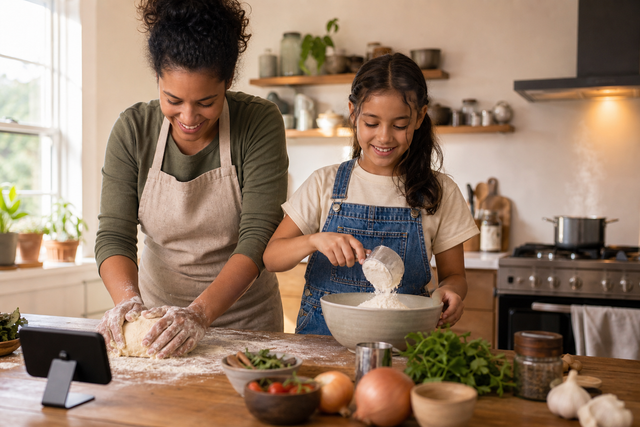
Someone always asks it the same way, full and with their plate licked clean:
"How did you make this? I need the recipe!"
And you start to explain. But you notice right away that you can't say it in numbers. "Well… some flour. Enough that it feels right. Don't measure it, just add a little and taste. You'll know." Your hands know, but hands aren't a recipe. And that recipe isn't written anywhere — it lives only in your fingers and your memory, learned over years of repetition.
That's how it goes in a lot of families. The most beloved dish of all — the one people request for birthdays, the one whose smell tells you you've come home — is exactly the one that was never written down anywhere. It passes on only by standing alongside someone and watching. And one day, when there's no one left to stand beside, it's gone.
But what if you put it down — and the story along with it?
A recipe book with stories is one way to preserve a family's life as a book. You'll find the other ways and the whole process in our overview guide, writing a book about your own life.
A recipe book preserves more than instructions
When you picture a family cookbook, you probably picture a stack of instructions: ingredient list, method, oven temperature. Anyone can get that from a cookbook or off the internet. But a family's own recipe book is something else entirely, and its value lies in exactly what a store-bought cookbook can never have.
Every one of your dishes has a story. The pierogi learned in a grandmother's kitchen. The curry you figured out as a flatmate and that, over the years, became your version. The cake baked for every single birthday, because one year it wasn't and that ended in tears. The meatballs that taste different from anyone else's, because of that one secret ingredient your mother never agreed to reveal.
The recipe tells you how the food is made. The story tells you why it matters to you — who you got it from, when you eat it, who it brings to mind. When the two sit between the same covers, you get a book you can't buy anywhere. It's as much a family history as it is a cookbook.
What goes into your recipe book — more than recipes
Don't think of this as just a collection of instructions. Think of it as a book that happens to tell the story of your family through food. Here are a few directions — pick whichever feels most like yours.
The everyday dishes that are yours
Start with what you actually eat. That weekly stew. The quick weeknight dish that rescues a tired Tuesday. They may not feel grand, but they're the taste of your family's ordinary days. A decade from now your child will remember precisely these — nothing fancy, just the familiar food that meant home.
The dishes of celebration and tradition
Christmas dishes, midsummer grilling, birthday cakes, the Easter bake. These are worth writing down carefully, because they're the ones people want to repeat exactly right even when the person who used to make them is no longer in the kitchen. Tell, at the same time, where the tradition came from and how your family marks it.
Inherited recipes — the chain of generations
Here's the heart of the book. Grandma's instructions, a mother-in-law's secrets, that grandfather's fish soup nobody has ever quite reproduced. If some of these still live in someone's hands but on no piece of paper, now is a good time to capture them — before they disappear. This is the same idea as the broader work of preserving your family history, but told through food: every recipe is a piece of your family's past.
Your own creations and culinary journeys
A recipe book doesn't have to be a museum. Just as much, it includes the dishes you invented — perhaps learned from another food culture and reshaped to your own taste. That Indian or Chinese dish you first made by the book and that, over the years, became something entirely your own through your particular blend of spices. These are the heirloom dishes of the future: what is your invention is, to a grandchild, "the dish our family has always made."
The children's baking
If there are eager bakers in the family, give them their own pages. The cocoa buns made together on rainy days. The brownies a child already knows by heart. When a child sees their own recipe — and their own name — in a printed book, cooking becomes something they belong to. It's also a fine way to bring the children into the whole project.
The story behind each dish
This is the part that makes it a book rather than an instruction pad. Beside each recipe, a couple of lines: where it came from, who taught it to you, when you eat it, what memory it brings up first. These are the very lines that will still be read long after the food itself has been learned by heart.
A book that keeps real food alive
There's one more reason to do this, and it's bigger than nostalgia.
More and more meals now come out of a package: ready meals, convenience food, freezer to oven. It's fast, but with it a skill quietly disappears — the matter-of-fact ability to make real food from real ingredients that earlier generations had without thinking. When recipes live only in one person's hands and don't pass on, what replaces them isn't new hand-skill but the supermarket's ready-made shelf.
A family recipe book is a quiet pushback against that. It isn't only the preserving of memories — it's the handing on of a practical skill to the next generation. When your child moves into their own home and the book goes with them, they hold a concrete reason and means to cook for themselves: familiar instructions, familiar flavours, familiar comfort. That's a far more inviting path back to the kitchen than any nutritional guideline.
In other words, you do two things at once. You preserve your family's flavours — and you give your children what they need to make real, home-cooked food even when it would be easier to buy it ready-made.
"But I'm no writer — and I'm no chef"
This is where many people shake their heads. "Lovely idea, but I can't write a book. And I don't measure anything, I can't even explain how I make this."
And that's exactly the heart of it: you don't need to write anything — and you don't need to measure. You just have to talk while you cook, the way you always have.
Think for a moment about when it would be impossible for you to sit down and write: precisely when you're cooking. Your hands are in the dough, your fingers are in the flour, the pot is boiling. But you can talk the whole time. And that's the secret of this.
In practice it works like this: you open your phone, press record, and narrate what you're doing as you do it. "I take an onion, roughly this size, and sweat it in butter until it's soft — not browned, just barely translucent." You tell it the way you'd teach the child standing beside you. After that, AI turns your speech into the text of a book — it transcribes your narration, picks out the ingredients and the steps into a clear recipe, and assembles the stories into something readable.
This is exactly how you capture what no measuring cup can reach: that "a little of this and a little of that" knowledge that lives in your hands. When you narrate aloud what you're doing, even the wordless skill becomes words. And the book sounds like you — your way of talking about food, your tips and your warnings ("don't boil it too hard or it'll go tough").
How to do it in practice
Keep the threshold low and the project will actually get finished. Here's the simplest way:
- Record when you're cooking anyway. Don't set up a separate "writing session." When you make Sunday's stew, just press record and narrate as you go. One dish, one recording.
- Narrate as if you were teaching. Give quantities the way they come out of your mouth — "a handful," "enough to cover it," "to taste." The AI shapes them into a readable instruction, and that verbal looseness is part of the book's charm.
- Add the story afterward. Once the dish is narrated, tell briefly where the recipe came from and what memory it carries. A sentence or two is enough.
- Don't worry about order. Record dishes in whatever order you happen to make them. The AI organizes them into a book — starters, mains, bakes — afterward.
- Bring the family in. Let your partner record their own specialities and the children narrate their bakes. That way the book becomes the whole family's, and everyone's voice is on the pages.
- Finally, finish the book. When the recipes are gathered, they're turned into a finished printed book or e-book you can keep on the kitchen shelf and print a copy of for every member of the family.
If you like, the project can be ongoing: you add a recipe whenever you make something that deserves to be kept, and the book grows little by little. Nothing forces you to get it all done at once.
A gift that smells of home
Most gifts are forgotten. A family recipe book runs the other way: the older it gets, the more valuable it becomes.
When a child moves out, the book goes with them and the kitchen smells of home right away. When someone in the family misses you, they make your dish and get you back for a moment — taste is a stronger memory than any photograph. And when a grandchild one day opens the book, they don't just learn to make the pierogi. They learn that it came from a great-grandmother's kitchen, and that your family has been making it for a hundred years.
The same idea by which a grandparent preserves their memories for a grandchild works here through food: every dish is a piece of you, one that lives on long after everyone has left the table.
Where to start right now
Don't try to map your whole family's food heritage at once. Start with one dish — the one someone in the family asks for most often.
Maybe it's that stew. Maybe the cake. Maybe the curry you've made so many times you no longer remember the original recipe.
The next time you make it, take out your phone. Open Vellu.ai, press record, and narrate what you're doing — as if you were teaching the child standing beside you. At the end, tell where the dish came from for your family. Stop there.
Next week you'll record another. And one day someone in your family will open the book, make the dish by the recipe, taste it — and smile, because it tastes exactly the way it should.
Frequently Asked Questions
I can't measure anything, I cook by feel. Can you still make a recipe out of that?
Yes — and this is made precisely for you. Just narrate aloud what you do, the way you'd teach someone beside you: "a handful of flour," "enough that it feels right," "sweat it until it softens." The AI turns this into a readable instruction. That by-feel knowledge, the kind never written down anywhere, is the most valuable thing to capture — and by talking, it works even if the measuring cups stay in the cupboard.
Do I have to write the recipes up myself?
No. You talk, the AI writes. It transcribes your narration, separates the ingredients and the steps into a clear recipe, and assembles the stories you tell into something readable. Your job is the part you already know how to do: cook, and talk about it.
How do I get the stories and memories in, not just the instructions?
Tell them aloud after the recipe. Once you've narrated the dish, keep going for a moment: who you learned it from, when your family eats it, what memory it carries. These are captured in the same recording, and in the book they sit beside the recipe. They're exactly what turns a recipe book into a family book.
Can the whole family take part?
Yes, and it's worth doing. Everyone can record their own specialities: one parent their dishes, the children their bakes. That way the book has many voices and becomes the whole family's. For children, it's also a nice way to get them into the kitchen and into the making of the book at the same time.
Will the book be printed or digital?
Either — or both. You can have a durable copy printed for the kitchen shelf or as a gift for each member of the family, and keep a digital version on your phone while you cook. You'll find more on going from finished text to print-ready in the guide speak your book into being.
How much does this cost?
Done with AI, the project is considerably cheaper than commissioning a book the traditional way. Vellu.ai runs on credits, which you can buy as one-time packs or as a monthly subscription. Recording is free, transcription costs only one credit a minute, and new users are given credits at no charge to get started. You'll find exact prices on the pricing page.