"Grandma, what did you do when you were little?" — Turn Your Memories into a Book for Your Grandchild
1 June 2026
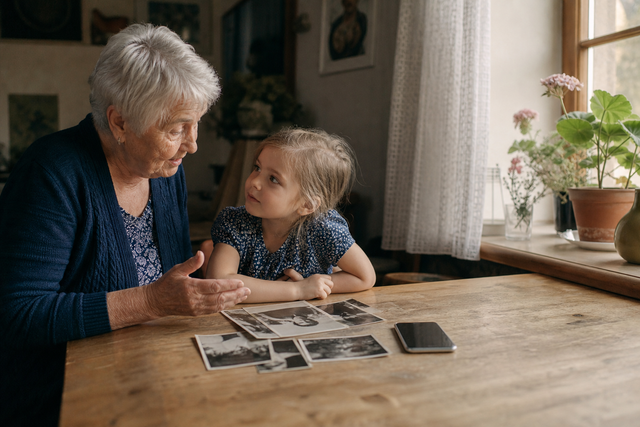
Your grandchild climbs into your lap, looks you in the eye, and asks something nobody else in the world can answer:
"Grandma, what did you do when you were little?"
You start to tell them. You tell them about the woodshed and the dog that followed you to school. You tell them how the milk was fetched from the farm in a churn, and what it felt like the day electricity finally reached the house. Your grandchild listens, mouth open — and then the coffee is finished, coats go on, and the visit is over. The story is left unfinished.
And next time, you talk about something else.
That's how it goes. A grandparent's life holds hundreds of stories that get told once, half-told, and then vanish at the kitchen table the moment the subject changes. They don't vanish because they're worthless. They vanish because nobody ever put them down somewhere safe.
But what if you did?
This is one way to make a book about your own life — aimed directly at your grandchild. For a broader overview of the different starting points, see our guide, writing a book about your own life.
Why you — and why now
Here's something worth saying plainly, even if it touches a tender spot: you are the only person in the world who can tell your grandchild certain things.
You are the only one who can tell them what their own mother or father was like at five years old. What they looked like asleep in the pram. Which words they got wrong. What made them cry, what made them laugh, what they were afraid of in the dark. Your grandchild can never remember their own parent as a child — but you can. That memory exists only inside your head, and nowhere else in the entire world.
And you are also the bridge to a vanished world. You remember the time before mobile phones, before the internet, perhaps before there was a car in the yard. You remember what it was like when the telephone hung on the wall with a cord attached. You remember the stories your own parents told you about the war years and the lean years. When you tell these things, your grandchild isn't reading history from a textbook — they're hearing it from someone they love. That is an entirely different thing.
And this bridge isn't here forever. This is the part that stings a little, but leaving it unsaid would be dishonest: memories are best captured while they're still vivid in your mind and while your voice still carries. Not because anything is urgent right this minute, but because "someday soon" has a way of coming and going unnoticed. Many families realise only too late how many stories left with the person who held them — and there's no getting them back, by any means.
The good news is that none of this has to be heavy or mournful. Quite the opposite: for most grandparents, telling the old stories is a warm and cheering thing to do. It's just worth doing now rather than someday.
How this differs from someone interviewing you
Maybe someone has once suggested that a grandchild or another relative could interview you and gather your stories into a book. That's a lovely approach, and if you have an eager interviewer, take them up on it.
But this is something else. Here you are the author — not the interviewee. You aren't waiting for someone to find the time to sit with you and think up questions. You decide what to tell and in what order. The book turns out to look and sound like you, in your words and your emphases. It's a self-portrait, not an interview.
And unlike a broad family history, which maps out generations and branches of the family tree, this book is one to one: from you to them. One person's voice, for one beloved person. It's allowed to be small and personal — that's exactly where its value lies.
What only you can tell
If you're wondering what a book like this even talks about, here are a few directions. Don't try to cover everything — pick whatever feels most yours.
The world your grandchild never saw
Describe the everyday life of your childhood in as much detail as you can remember. What you ate. How the house was heated. What you played in the yard. What you did when you were bored — with not a single screen to look at. What school felt like, who the teacher was who really saw you, and who the one was who didn't. What you dreamed of being when you grew up.
These details are priceless precisely because they're completely foreign to your grandchild. To them, milk comes from a shop and music comes from a button. Through you, they get to step for a moment into a world that no longer exists.
Who their own parent was as a child
This is the most beloved part of many such books. Tell your grandchild about their own mother or father — back when they were tiny. The first word. That defiant phase. The favourite toy dragged everywhere. The time they got lost in the shop. The thing they were already, as a small child, exactly the way they still are as an adult.
When your grandchild reads this as a grown-up, something wonderful happens: their own parent becomes, for a moment, a person who was once as small and helpless as they themselves once were. It's a gift not only to the grandchild, but to their parent too.
The roots and stories of the family
You are most likely the family's memory. You know where great-great-grandmother came from, why the family moved to where it is now, which house it was that burned down, and who that relative was the stories were told about. When these aren't written down anywhere, they disappear within a generation. When they are, they last a century.
What life taught you
You don't need a sermon or a set of life rules. It's enough to tell, honestly, what life taught you — what you're proud of, what you regret, what you'd do differently, and what turned out to matter in the end and what didn't. This is the part your grandchild will read again and again as an adult, at their own crossroads.
What you wish for them
The keynote of the book. No demands, no expectations — just what you truly wish for your grandchild's life. Many readers pause at this part, and it's the very passage that gets read aloud even when you're no longer there to say it yourself.
"But I'm no writer"
This is the point where many grandparents shake their heads. "Lovely idea, but I can't write a book. I've never written anything. And my eyes and fingers aren't what they used to be."
And this is the whole heart of the matter: you don't have to write anything. You only have to talk.
Talking is the skill you already have. You've been telling stories your whole life — at the coffee table, on the sauna benches, with a grandchild in your lap. This is that exact same thing. The only difference is that now someone puts it down somewhere safe.
In practice it works like this: you open your phone, press record, and tell the story. Just as if you were telling your grandchild face to face. After that, the AI turns your speech into the text of a book — it transcribes it, arranges the stories, and shapes them into readable chapters. You don't have to write, and you don't need any structure planned in advance. You just say whatever comes to mind, and the pieces are put in order later.
This isn't merely a matter of convenience. A story told aloud sounds like you. It carries your humour, your way of pausing before the important part, your words. Written down, those things often disappear and the text turns stiff. Spoken, they survive. From the pages, your grandchild hears you.
What to talk about — when you don't know where to start
A blank page is intimidating. A blank recording isn't, once you have a few questions to answer. Take any of these and talk about it for five minutes:
- What is your earliest memory? Tell it in as much detail as you can.
- What was the home you grew up in like? Walk through it in your mind, room by room.
- Who was the most important person to you as a child, and why?
- What was your first job? What did it pay, and where did the money go?
- How did you meet your spouse? What were you wearing that day?
- What was your happiest day? And your hardest?
- What did your grandchild's parent do as a little one that you'd want them to know about?
- What would you most want your grandchild to remember about you?
One question, one recording. You don't need any more than that. Once you've worked through a couple of dozen of these, you'll suddenly have a whole book's worth of story on your hands.
How this is done in practice
It pays to keep the threshold low — that's also how the project actually gets finished. Here's the simplest way:
- Record whenever it suits you. Over morning coffee, in a quiet afternoon moment, whenever a story happens to come to mind. One recording can be five minutes or twenty — however much you're up to.
- Don't worry about the order. Tell the stories in whatever order they come to you. The AI arranges them into a book afterwards.
- The AI does the heavy lifting. Transcription, structuring, and shaping the chapters happen in minutes, not months.
- Ask for help if the phone isn't familiar. This is a natural moment to bring in a child or grandchild: they show you where to press record, and you handle what nobody else can — telling the stories.
- Finish the book at the end. Once the material is gathered, it's turned into a finished printed book or e-book that you can give as a gift or have printed for the whole family.
If you like, you can make the project an ongoing one: add stories whenever they come to mind, and the book grows little by little. Nothing forces you to get it all done at once.
A gift that grows in value
Most gifts from grandparents — toys, clothes, sweets — delight for a moment and are forgotten. This gift runs the other way: the older your grandchild gets, the more valuable it becomes.
As a small child, they'll look at the pictures and listen while a parent reads it aloud. As a teenager, they may forget it on a shelf. But as an adult — when they start their own family, when a child of their own is born, when one day they simply miss you — they'll take the book in hand and hear your voice again. And their own children will get to know who their great-grandmother was, even though they never had the chance to meet her.
This book has no final reading day. It remains the family's treasure long after today's gifts are forgotten.
Where to start right now
Don't start at the beginning. Don't try to work out where the whole life story is supposed to begin. Start with one memory — the one that comes to mind right now.
Maybe it's that same woodshed. Maybe the dog that followed you to school. Maybe the day your grandchild's parent said their first word.
Pick up your phone. Open Vellu.ai. Press record and tell that one story, the way you'd tell it to the grandchild in your lap. Stop there.
Tomorrow you'll tell another. And one day your grandchild will open the book, read the first page, and hear the voice they've been missing — your voice, telling them: when I was little…
Frequently Asked Questions
I've never written anything. Can I still do this?
Yes — and it's made for you in particular. You don't write a single line; you talk, just as if telling a story at the coffee table. The AI turns your speech into text and arranges it into a book. The only skill you need is the one you already have: the ability to tell a story.
I'm not very good with a phone. Will I need help?
Recording is simple — in practice it's the press of a single button. If the phone isn't familiar, ask a child or grandchild to show you once how to start and stop a recording. After that you'll manage on your own. Many people make this a pleasant shared moment: the younger one handles the technology, you handle the stories.
How long does making the book take?
As long or as short a time as you like. One way is to record a couple of dozen short stories over a few weeks — then the book comes together quickly. Another is to tell a story now and then, whenever one comes to mind, in which case the book grows gradually over months. The AI's part — transcribing and structuring — takes only minutes.
What if I don't remember things accurately?
That doesn't matter. This isn't a history book but your memories, and memories are allowed to be the way they are for you. Tell things as they stand in your mind — that's exactly what makes the book look like you. Exact dates and details matter far less than the feeling and atmosphere you convey.
Can the book be for all my grandchildren rather than just one?
Absolutely. You can address all your grandchildren together in the book, or make a single book that's printed as an individual copy for each. The same story serves the whole family. If you like, you can also add a small, personal section for each grandchild.
Is this the same thing as memoirs or a biography?
Related, but not the same. Memoirs tell your own life from your point of view, for any reader. This book is aimed directly at one person — your grandchild — and its tone follows suit: warm, personal, from you to them. Many people do both, and one often comes about as a by-product of the other.
Is there an equivalent book a parent makes for their child?
There is. If you're drawn to another form of the same idea, read write your parenting wisdom into a book for your teenager — there, a parent captures their own lessons for their child to read as an adult. The same idea, a different generation.
How much does this cost?
Made with AI, the project is significantly more affordable than traditional writing or hiring a ghostwriter. Vellu.ai runs on credits, which you can buy as one-off packs or as a monthly subscription. Recording, the AI's summaries and automatic organising are free; transcription costs one credit a minute, and new users are given 100 credits at no charge to get started. Exact prices are on the pricing page.