Writing a Book About Your Child's Childhood — Even If the Baby Album Stayed Empty
27 May 2026
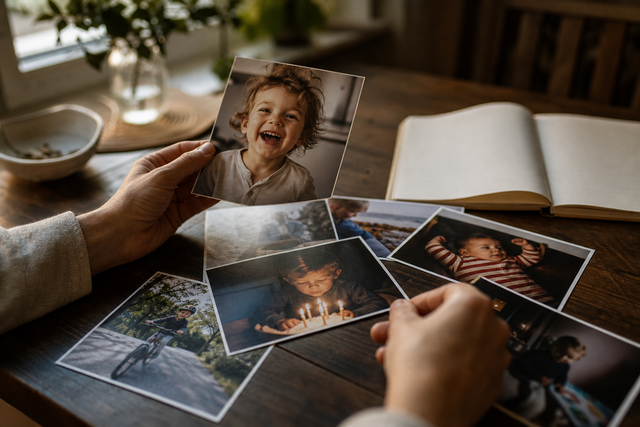
There's a baby book on the shelf. The first pages are filled in carefully: birth weight, first smile, first tooth. Then the entries thin out. At some point they stop altogether — perhaps a second child arrived, perhaps work took all your energy, perhaps life simply moved on so fast that you never managed to go back to the book.
Now your child is a teenager, or maybe already moving out. Daily life has finally slowed down. And you find yourself thinking, more and more often, about all those years that never got written down. You remember them, of course — the funny phrases, the strange games, the nervous first day of school, the summer at the holiday house when she learned to swim. But the memories live only inside your head. They were never written down anywhere.
This article is for you. The empty pages of the baby book can't be filled in retrospectively — but your child's childhood can still be turned into a book. You don't need writing skills or months of free time. All you need are your memories and the chance to speak them out loud.
Capturing a child's childhood is one of many ways to turn a life into a book. Our overview guide, writing a book about your own life, gathers all the options and the whole process in one place.
Why now is the perfect time to write
Daily life has finally slowed down
When a child is small, a parent's day is one long act of survival. Nights are short, the laundry basket is overflowing, the calendar is packed with health visits and nursery events. No parent in their right mind has the energy at that stage to sit at a desk in the evening and write their memoirs. That's human, not a failing.
But things are different now. The child does their own homework, goes to the shop on their own, perhaps lives elsewhere for part of the week. For the first time you have the space to look back — and the calm that remembering needs.
The memories are still alive
Many parents fear that their memories of their child's early years have already faded. Usually they haven't. As soon as you start speaking them out loud, you'll be amazed how many details come back to you. One memory opens the door to the next, and before you know it you're in the middle of a day from 2010 as if it happened last week.
But memories don't last forever. The more time passes, the more details slip away. Right now — when childhood is behind you but still close — is the ideal moment to record them.
Your child is at an age where the book starts to mean something
You can't really talk about a book with a toddler. A teenager can feel distant — but that's exactly when a book about their childhood can be an unexpected bridge. It says that you, the parent, remember and value those years. It tells them things they don't remember themselves. It is a gift that strengthens their sense of identity at precisely the stage of life when a young person is searching for who they are.
And if your child is already an adult, the book takes on a different meaning again. They can read it themselves and one day share it with their own children.
What a childhood book might contain
This is the most common place where people pause: what would I actually write about? A good childhood book isn't a dry list of events. It's a portrait of a person who grew up under your eyes. Here are some topics every parent will find they have surprisingly much to say about.
Personality and character, from the very start
What was your child like as a baby? Fussy or calm? Curious or cautious? Which traits were there from the beginning, and are still there now? What made them laugh? What frightened them? This is often the most important part of the childhood book — a portrait of the person your child was before they could speak for themselves.
Words, sayings and odd theories
Every child invents their own words, sings the wrong versions of songs and comes up with extraordinary explanations for the world. "The washing machine is a house where the clothes go swimming." "When the clouds get annoyed, they drip." These are the first things that get forgotten — and exactly the things your child loves to read about as an adult.
Firsts
The first steps. The first word. The first friend. The first day of school. The first bicycle without stabilisers. The first proper hobby. The first trip into town alone. You won't remember every date, but you'll remember the moments — and that's enough.
Ordinary days
This is the underrated part. Big events are remembered in photographs, but ordinary days disappear. What did your morning routine look like when your child was five? What did you eat on Sundays? Who picked them up from nursery? What did you listen to in the car? Details like these make the book come alive — and they're exactly what the child wants to know about as an adult.
Difficulties and how you got through them
There is always something hard in childhood. Sleep problems, friendship troubles, school, illness, the loss of a loved one, a parents' separation. There's no need to hide these — often they are exactly what your child wants to read about as an adult. What matters is also telling how things were got through, and what was left behind in the end.
Relationships
Siblings and the dynamics between them. Grandparents. Cousins. The neighbours' children. Pets. The carer at the local nursery who was something special. The teacher who saw your child for who they really were. The book tells the story of your child — but it also tells the story of the people who shaped them.
The child's inner world
What did your child love? Which games were repeated again and again? Which cartoons did they talk about for months on end? Which one soft toy went everywhere with them? What did they want to be when they grew up? What did they fear? This is a portrait of the child's inner world — and it fades faster than you'd believe.
How to get the memories out of your head
Many parents recognise the feeling: there are lots of memories, but as soon as you sit down to write, nothing comes to mind. This isn't a failure of memory — it's the nature of writing itself. The brain works differently when you're writing than when you're remembering.
Speaking, on the other hand, lets the memories out. When you sit down and start telling them out loud, one memory leads to another, and suddenly you're flooded with details you didn't know you remembered. This is exactly why writing by speaking is such a good fit for recording a childhood.
Use photographs as memory keys
Open the photos on your phone, an old album or the family cloud archive. Scroll through and speak out loud what you remember. "Here's the sausage-pasta supper at Grandma's. She had just learned to pedal and insisted on showing everyone." One photo usually unlocks several memories.
Use calendars and the leftovers of calendars
Old wall calendars, school diaries, the child's drawings, kept artwork, the first letters to Father Christmas. All of these are doorways into memory. Take one at a time and tell what you remember about it.
Ask the child themselves
Even if the book is from your perspective, your child is often the best collaborator. They remember things you don't — and the other way around. Sit down together and reminisce out loud. Record the conversation. This is often more valuable than speaking alone, and it can produce a moment of unexpected closeness.
Remember in time periods
Start with a single, narrowly defined period. "The first year", "nursery age", "the first year of school", or "the summer we moved into the new house". When you limit the subject tightly enough, more memories start to come than you'd believe.
Use the other parent and other loved ones
If your child's other parent is available, remember together. Two people remember more than one, and two sets of memories complete each other. The same goes for grandparents, who often recall things from your child's early years that you yourself never noticed.
The book's structure — two practical models
Chronological structure
The simplest way is to move through time: babyhood, toddler years, nursery, the first year of school, primary years, secondary school. This works brilliantly if you want the book to show how your child grew step by step. It's easy for the child themselves to follow the story, and it suits a gift book for a milestone — an 18th birthday, say, or a moving-out present.
Thematic structure
The other option is to organise the memories by topic: one chapter about friendships, another about hobbies, a third about family trips, a fourth about school. This structure emphasises the child's personality more than a timeline, and it often makes for a more engaging read than pure chronology.
You can also combine the two: a chronological backbone with thematic interludes inside it. A good tool will help you work out the structure only once the material has built up — you don't need to decide it in advance.
What if you have several children
This is a common point of reflection. There are essentially three options.
One book for each child. Every child gets their own book. This is an especially lovely gift, because it sends a message: each of you is your own, unique person with your own story. The workload is higher, but the result is deeply personal for each.
One shared family book. The childhoods of all the children in a single book, told from the family's point of view. This works particularly well when the children are close in age and their stories are tightly interwoven. The result is more "the story of our family" than the biography of any one child.
A hybrid: shared sections and individual sections. The book opens and closes with the family as a whole, and in the middle each child has their own section with their own memories. This is a little more demanding to put together, but it gives you the best of both worlds.
None of these is the wrong choice. The important thing is to start — you can also make a book for one child first and see how it feels before deciding whether to do the others.
How much time does this take
Here's some good news: in the age of AI, making a book about a child's childhood doesn't take years, it takes weeks. The practical scale is roughly this:
- Recording: 10–20 recordings of 20–30 minutes each. About 5–10 hours of speech in total — spread across evenings or weekends over a few weeks, this is perfectly doable alongside ordinary life. Shorter recordings work fine too; you can even record each little story separately.
- AI handles the background work: transcription, structuring and shaping into chapters take minutes once you have enough recordings.
- Reviewing and polishing the chapters: a few evenings once the material is in.
- Getting it ready to publish: add photographs, choose a cover, order it as a printed book or download it as an e-book.
All in all: about one to three months at your own pace. Compared with waiting for the "right time" to sit down and write, this is genuinely achievable.
Where to start if you're hesitating
Don't start at your child's birth. Start with the first memory that comes to mind right now. Maybe it's a funny saying your child invented when they were three. Maybe it's one particular day that stuck with you, even though you don't know why. Maybe it's a smell that belongs to the summer when they were six.
Record it. One memory, five minutes, no more. Listen back, or let the AI transcribe it into text. You'll notice how one memory unlocks ten more. From there, the journey takes care of itself.
The empty pages of the baby book no longer weigh on you. In their place comes something far more valuable: a real book, with real content, telling the story of your child's childhood as you remember it.
The childhood book is a gift you don't expect for yourself
Parents who make this book often report something unexpected: the book wasn't only a gift for the child. It was just as much a gift for themselves.
The act of remembering puts you back in touch with your own parenthood in a way that everyday life doesn't allow. You see how much happened. How much you did together. How much love went into those years, even though they passed faster than you could grasp at the time. Many parents say that after making the book, their bond with their growing child felt stronger than before — even before the book had been handed over.
And when the book is finally given — at a birthday, on graduation day, at the moving-out moment, at a wedding, at the birth of a grandchild — it is a gift whose value doesn't age. Your child's grandchild will be able to read it one day and come to know their grandparent as a child.
An unfinished baby book is not a failure. It's just a sign that you were busy living. Now is the time to write down what was being lived.
Frequently Asked Questions
I've forgotten so much already — is my memory enough to make this book?
Almost certainly yes. Most parents overestimate what they've forgotten and underestimate what they remember. Once you start speaking, more memories come than you'd believe. Photographs, your child's keepsakes and conversations with your partner or the child themselves will fill in the rest.
My child isn't an adult yet — is it too early to make this kind of book?
Not at all. In fact, many parents time the book to the threshold of adolescence or adulthood: as a confirmation present, an 18th birthday gift, a graduation present, or a moving-out gift. That way the book has a natural context in the arc of life.
Can the book be made together with the other parent?
Yes, and it's often a lovely choice. You can record conversations together, share the work of remembering, and the book becomes more layered when both perspectives are included. The same is true if the child's parents are no longer together — the book can still be made jointly, if the relationship allows.
What if there were difficult things in the childhood?
Difficulties usually belong in a childhood book — they don't need to be hidden. Illness, changes in the family, struggles at school, troubles with friends are all part of real life. What matters is how they are told: with warmth, honestly, and showing also how things were got through. As adults, children value honesty far more than an idealised picture.
What if my child doesn't like the book?
This worry turns out to be surprisingly rarely justified. Almost every child — whatever their age — finds it deeply meaningful that a parent has remembered and recorded their childhood. Even if a teenager doesn't show it straight away, the book stays safe and gets read again and again later on.
Can the book be made even if there are only a few memories?
Yes. A short book of 30–50 pages of genuine memories is worth many times more than an unfilled baby album. Vellu.ai suits both large and small projects — you can confidently start small and carry on later if the urge grows.
How much does making a childhood book cost?
Made with AI, a childhood book is significantly more affordable than traditional writing or hiring a professional ghostwriter. Vellu.ai runs on credits, which you can buy as one-off packs or as a monthly subscription. Exact prices and per-operation credit costs are on the pricing page.