Family Reunion Stories — How to Capture Them and Turn Them Into a Book
11 June 2026
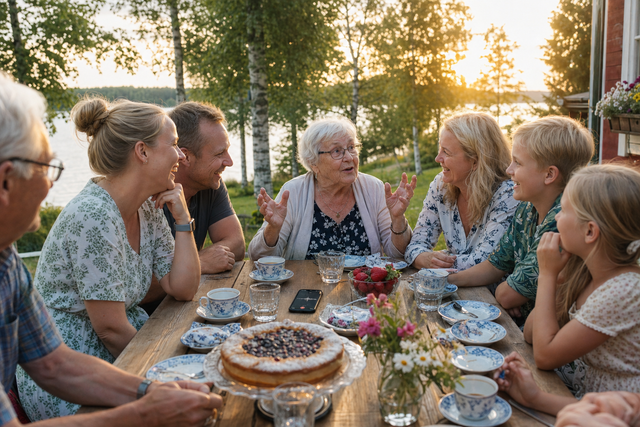
A family reunion is the best opportunity of the year to capture your family's stories: several generations are in one place, and one memory sparks the next. You capture them in three steps: agree on recording in advance, record the stories during the gathering as audio on a phone, and assemble the recordings into a book afterwards — AI transcribes the speech and turns it into fluent text, so nobody has to become a writer.
Summer gathers families together: a midsummer party at the cottage, a reunion, a milestone birthday, a graduation. It's at these tables that the stories get told that nobody thinks to write down — and that are forgotten again by the next summer. "We'll ask next time" is the most common fate of family stories, and next time doesn't always come. This guide shows how to make this summer's gathering the one where the stories actually get saved. Capturing family stories is one way to turn a life into a book — for the whole picture of the different starting points, see our overview guide, writing a book about your own life.
Why is a family reunion the best moment to capture family stories?
At a reunion, the stories tell themselves. When cousins, siblings and different generations sit around the same table, one memory ignites another: someone starts, another corrects, a third remembers the ending nobody else knew. This kind of storytelling doesn't happen in a one-on-one interview, because the memories complete each other precisely in the back-and-forth between tellers.
The opportunity is also rare. Many families gather in full only once a year or less, and for the oldest generation, any gathering may be the last at which a particular story can still be heard. That's why the recording is worth doing now, not "sometime" — a summer that goes unrecorded doesn't come back.
How do you prepare to collect stories before the gathering?
The most important preparation is simple: say in advance that stories will be recorded, and ask permission. When it's mentioned in the invitation or the family group chat, nobody is taken by surprise, and many will already start recalling things to tell. A direct phrasing works: "We'd like to save the family's stories for the children and grandchildren — we'll record a few sessions at the party, if that's all right with everyone."
After that, three small tasks are enough. Name one or two people responsible for recording, so it doesn't become everyone's job and therefore nobody's. Think up a handful of questions or topics in advance — an old photo album, the family's home place, the grandparents' youth. And ask people to bring photographs or objects that carry a story: one object on the table opens people up more effectively than any list of questions. For one-on-one interviewing technique, there's a more detailed guide in recording elders' stories.
How do you record the stories during the gathering?
A phone is enough — no separate equipment needed. Record audio, not video: a voice recording is quickly forgotten by the teller, while a camera makes many people freeze up. Lay the phone on the table near the tellers and let the conversation run at its own pace.
Two practical tips clearly improve the result. First, choose calmer moments for recording — the coffee table, the evening after the sauna, a walk in the garden — because the simultaneous chatter of dozens of people is hard listening for transcription too. Second, record several short sessions rather than one long one: one story or topic at a time is much easier to title and organise afterwards. Remember also to ask out loud at the start of each recording that everyone present is happy to be recorded.
A story session in the reunion programme — three formats that work
Story collecting can also be a programme item that needs no host and no performing skills. These three formats work in almost any family:
1. The photo round
Spread old photographs on the table and let everyone pick one. Whoever chose the photo tells what's happening in it, who's in it and what they remember about it — and the others fill in. A photograph is a merciful opening, because it hands the teller a ready subject.
2. The one-story round
Everyone takes a turn telling one story on a given topic: "my first day at work", "how I met my spouse", "my best midsummer memory", "the time things went sideways at grandma's". A short, bounded task lowers the threshold — nobody has to give a speech.
3. Children interview the grandparents
Let the children ask the questions: "Granny, what was the worst school food?" or "Grandpa, what did you do when there were no phones?" Grandchildren get told stories that adults never would be, and the youngest generation hears them first-hand. This is often the best programme item of the whole party — and as a recording, irreplaceable.
If your family's stories revolve around food, it's worth capturing the recipes at the same time: a family cookbook with stories has its own guide.
How do the recordings become a book after the party?
After the party you're holding a pile of audio files — and this is exactly where most projects used to die, because nobody had time to transcribe the tapes. Today AI does it. On Vellu.ai you upload the recordings (or record directly in the browser), and the speech is transcribed and summarised automatically — recording and summaries are free, and transcription costs only one credit a minute.
Then the material is organised into a book. AI tags each recording with 3–8 topic tags and identifies when the stories took place ("summer 1962", "the early 1980s"), so different tellers' memories of the same time and subject find each other when chapters are assembled. The AI suggests a structure for the book and turns the spoken stories into fluent text; you decide what makes the cut. You can add the party photos and the album treasures to the chapters. When it's ready you can order the finished book as a printed copy delivered to you, or download it as an e-book (EPUB), a print-ready PDF (trim sizes including A5, B5 and 6 × 9 inches) and a Word file — we cover the finishing stage in more detail in speak your book into being. And if you want to grow the book into a full family history, continue with family history as a book.
The best part: the finished book is the highlight of the next reunion. A book where the family's own stories are told in the family's own words is a gift no store-bought present can match — and it's guaranteed to spark new stories for the next edition.
Where do you start?
If a summer gathering is already in the calendar, there's plenty of time. Do this:
- Announce it and ask permission. Post a message in the family group chat: stories will be recorded so they survive for the children and grandchildren.
- Name a recorder and pick a format. Decide who looks after the recording and which of the three programme ideas above suits your party.
- Record the first story. Even one story saved is more than any previous summer has left behind.
What matters isn't a perfect plan but that the phone is on the table when the best story begins. Capture this summer — the book grows from there.
Frequently Asked Questions
Do I need permission to record at a family reunion?
Always ask — it's both polite and wise. Mention already in the invitation that stories will be recorded and what for, and confirm at the start of each recording that everyone present is comfortable with it. When the book is finished, let the tellers read their own passages before the book is shared with the family if they wish. Openness up front saves everyone trouble afterwards.
What equipment do I need for recording?
An ordinary smartphone is plenty. Lay the phone on the table near the tellers, pick a calm moment, and record audio rather than video — a camera makes many tellers freeze, while a voice recording is quickly forgotten. No separate microphones are needed as long as the background noise is reasonable.
How do I get shyer relatives to tell stories?
Give them a ready, bounded subject. Few people warm to "tell us something", but an old photograph, an object or a precise question ("What was your first day at work like?") hands the teller a ready opening. A smaller circle helps too: many people will tell three listeners at the coffee table stories they'd never tell the whole party. And once someone else starts, even the shy continue — memories are contagious.
Can stories from many different tellers become one book?
Yes — and that's exactly where a family book's richness comes from: the same event as remembered by different people. In practice you record or upload each teller's sessions as their own recordings, and the AI's topic tags and time-period data help gather different tellers' memories into the same chapters. You can choose a style that preserves the tellers' own voices — or edit the stories into a single unified narrative.
What does capturing family stories cost?
Recording and summaries are free on Vellu.ai, and transcription costs only one credit a minute, so collecting a whole summer's stories costs very little. Most of the credits go toward turning the stories into book chapters, and a new user gets 100 free credits to start with. The costs can also be shared across the family — many families assemble the book together.
Is there still time to organise this if the party is next week?
Yes. The preparation amounts to one message in the family group chat and a handful of thought-out questions — both done in an evening. A story session needs no host and no schedule: a phone on the table at coffee time and one good opening question are enough. The book can be assembled at leisure afterwards; at the party, all that matters is getting the stories recorded.