Turn Your Love Story into a Book — An Anniversary Gift You Can't Buy
16 June 2026
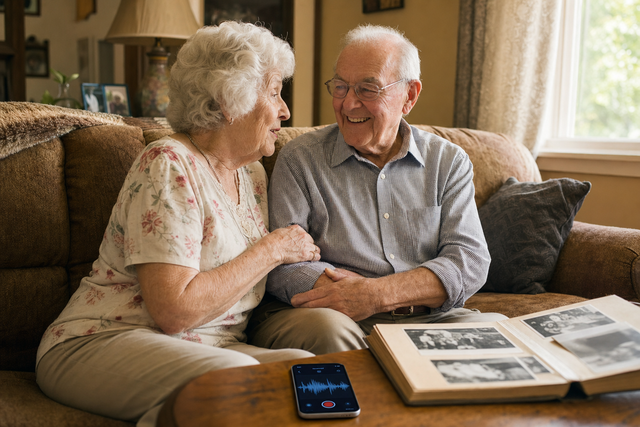
You turn your own love story into a book by telling it aloud — how you met, how a shared life took shape, and which moments mattered most — and AI assembles the speech into a readable book. You can do it together, taking turns reminiscing, or one of you can do it in secret as a surprise gift for an anniversary. You need no writing skill and no finished manuscript, only the memories and a few spoken moments.
Sooner or later someone asks it out loud — maybe a grandchild who plops down beside you and asks straight out: "How did you and Grandma actually meet?" And you start to tell it: the dance hall, the wrong bus, the evening it all nearly went sideways. The story is funny, and it's yours — but it isn't written down anywhere. It lives only in the two of you, and one day only one of you will remember it. This guide is about getting it down as a book. A love story is one way to preserve a life as a book; you'll find the other ways and the whole process in our overview guide, writing a book about your own life.
Why turn your own love story into a book?
Because it's your family's founding story, and it's been preserved nowhere. Everything else in the family — the children, the home, the shared life — began the moment the two of you met. Yet that very story travels only as talk, and the details fade year by year: the street name is forgotten, the date gets muddled, the funny line disappears.
As a book, the story stays. It's a gift to a partner that says, without any flourish, "our story matters." It's a gift to children and grandchildren, who get to know where the whole family began. And it's a gift to yourselves: reminiscing together is rare, good time, and many couples find that making the book brings back things they haven't talked about in years.
What should go into a love-story book?
Don't think of this as a whole-life biography. Think of it as a book that tells the story of your relationship — from the start to right now. Here are a few directions; pick whichever feels most like yours.
How you met
This is where it all begins, and it's the part people want to read again and again. Tell the meeting as precisely as you remember it: where, when, who said what first. It's worth including what you thought of each other back then — including if the first impression was completely wrong.
How a shared life took shape
The first shared home, the engagement, the wedding, the moves, the jobs, the children being born. These are the turning points of the relationship, and the book naturally organises itself around them. You don't have to tell everything — it's enough to pick the moments that changed something.
The hard times you came through
Don't leave these out. They're exactly what make the story true rather than a postcard. Illness, grief, the heavy years, the times it nearly fell apart — when these are told honestly, the reader understands what your marriage has weathered. Decide together what you want to tell and what stays between the two of you; the book is yours, and you set the limits.
The small everyday things
The heart of the story is often not in the big moments but the small ones: the joke only the two of you understand, the nickname, the Sunday-morning routine, the argument about which way the dishwasher gets loaded. These are exactly what a grandchild loves to read — and exactly what's forgotten first unless it's written down.
What you've learned
Finish with a few words on what the years together have taught you. This makes a natural ending for the book, and it's the part your children and grandchildren read while measuring it against their own lives.
Make the book together, or in secret as a gift?
Either works, and the choice depends on what you want.
Together, both of you reminisce in turn, and the story gets two voices. This is the richest way, because your memories complete each other — and differ from each other, which is often the most fun part of the book ("that's not how it went, you called first!"). A good method is to interview each other: one asks, the other tells, then you swap. It's the same technique as recording an older person's stories — ask open questions and let the teller wander.
In secret as a gift, one of you assembles the story alone and gives it as a surprise on an anniversary, a wedding day, or a golden anniversary. Then you tell it from your own point of view: how you experienced the meeting, what you love about them, what the shared years have meant to you. Few gifts move someone more than hearing how their partner remembers the beginning. If you like, you can quietly bring in the children or shared friends to add their own memory of you as a couple.
"But I'm no writer"
This is where many people pull back. "Lovely idea, but I can't write a book. I've never written anything long in my life."
And you don't have to. You don't need to write a single line. You just have to tell your story aloud, the way you'd tell it to a good friend over a cup of coffee.
In practice it works like this: you open your phone, press record, and start reminiscing. "We met in the spring of '78, at one of those dance-hall nights, and I almost didn't go at all…" You tell it in your own words, winding and remembering, exactly as it comes to you. After that, AI turns your speech into the text of a book — it transcribes the speech, organises the memories into chapters, and shapes them into fluent, readable text that still sounds like you.
This is exactly why talking beats writing: a blank page is frightening, but telling a story comes easily to everyone. And when you tell it aloud, in comes the warmth and the way of speaking that vanish the moment you try to make things sound "literary."
How to do it in practice
Keep the threshold low and the book will actually get finished. Here's the simplest way:
- Start with how you met. First recording: the meeting. It's the easiest and most fun place to begin, and the momentum usually carries you onward from there.
- Reminisce one moment at a time. Don't try to tell your whole life in one sitting. One turning point, one recording — the wedding, the first home, a child's birth. The book grows piece by piece.
- Take turns. If you're doing this together, let both of you tell the same moment from your own point of view. Two memories of the same evening beat one.
- Don't worry about order. Record the memories in whatever order they come to mind. The AI arranges them into chronology and chapters afterward.
- Bring in the photographs. Old pictures jog memories and work as illustrations in the book. Look at a photo and tell what's happening in it.
- Finally, finish the book. When the story is gathered, it's turned into a finished printed book or e-book you can print a copy of for each of you and for the children.
If you like, the project can be ongoing: you add a memory whenever one surfaces, and the book fills out little by little. Nothing forces you to get it all done for a single anniversary.
A gift that grows more valuable
Most anniversary gifts are forgotten within a year. A book of your love story runs the other way: the older it gets, the more valuable it becomes.
At first it's a moving gift to a partner. Years later it's the children's treasure — a book about where the whole family began. And one day that grandchild who once asked "how did you two meet?" gets the answer in their hands as a whole book, told in your own words. When one of you eventually misses the other, the story is still there — and it can be read again like hearing a loved voice.
The same idea by which a grandparent preserves their memories for a grandchild plays out here as a couple's shared story: it lives on long after your story itself has been told to the end.
Where to start right now
Don't try to plan the whole book first. Start with one story — how you met.
Sit down one evening, take out your phone, and open Vellu.ai. Press record and tell that evening: where it was, what happened, what you thought of each other. If you're doing this together, let both of you tell your own version. Stop there.
Next week you'll record the next moment. And one day someone in your family will open the book, read how it all began — and understand that this story was worth telling.
Frequently Asked Questions
Can I make a love-story book in secret as a surprise gift?
Yes, and it makes a moving gift. You assemble the story alone from your own point of view: how you experienced the meeting, what you love about them, what the shared years have meant. You tell it all aloud, and AI turns it into a book you give as a surprise on an anniversary or wedding day. If you like, you can quietly bring in the children or friends to add their own memory of you as a couple.
What if we remember things differently?
That's not a problem but one of the book's best features. When you do this together, let both of you tell the same moment from your own point of view — two memories of one evening are richer than one, and the differences are often the most fun part to read. You can leave it visible in the book that you remember it a little differently; that's exactly what makes the story alive and yours.
Does the book have to cover the hard times too?
You don't have to, but it's often worth it. The hard times — illness, grief, the years it nearly fell apart — are exactly what make the story true rather than polished. You decide what you tell and what stays between the two of you. The book is yours, and so are its limits.
We're not writers. Can we still do this?
Yes, because you don't have to write anything. You tell your story aloud the way you'd tell it to a friend, and AI transcribes the speech, organises it into chapters, and shapes it into fluent text. Telling a story comes easily to everyone even if a blank page is frightening — and it's precisely by talking that your own voice gets into the book.
How long does it take to make a love-story book?
You can do it quickly or gradually, on your own schedule. Reminiscing about one moment takes only fifteen minutes to half an hour. If you want the book for a particular anniversary, give yourself a few weeks so you can record the story calmly in parts. For many couples the nicest way is to keep the book ongoing and add memories as they surface.
How much does this cost?
Done with AI, a love-story book is considerably cheaper than commissioning one the traditional way. Vellu.ai runs on credits, which you can buy as one-time packs or as a monthly subscription. Recording, the AI's summaries, and automatic organising are free; transcribing speech into text costs one credit a minute. New users are given 100 credits at no charge to get started. You'll find exact prices on the pricing page.