How to Write a Biography About Someone Else — Including a Living Person
30 July 2026
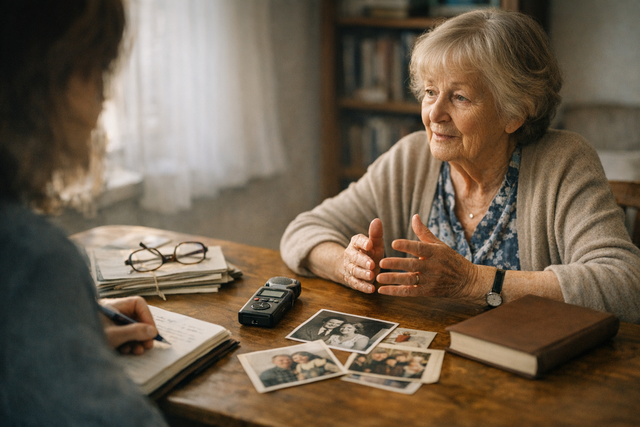
To write a biography about someone else, start by asking them — then record interviews rather than taking notes, agree early on whether the book will be in their voice or yours, and let them read a draft before anyone else does. When your subject is still living, the work is less research than relationship: they can correct you, contradict you, and ask you to remove things, and a biography that survives those conversations is a better book than one written around them.
This guide is about the particular case where the subject is alive and present. For the whole craft of biography — background research, studying the era, structure and ethics — start with our general guide to writing a biography, and for the wider picture of every way a life becomes a book, see writing a book about your life.
How do you start a biography about someone else?
You start by asking them, plainly and in person. Most people's first reaction is to deflect — "there's nothing to tell", "who'd want to read about me" — so ask a second time, and be specific about what you want: not their whole life, but the part only they can tell. A named subject ("your years at the shipyard") gets a yes far more often than "your life story".
It helps to say what you intend to do with it. A book for the family, printed in eight copies, is a completely different proposition from something you plan to publish, and people say yes to the first much more readily. Be honest about which one you mean, because changing the answer later is how these projects break down.
Once they've agreed, the practical first step is one short recorded conversation — twenty minutes, no plan, no questionnaire. It gives you a sense of how they tell a story, and it gives them the experience of discovering that talking is easy.
How is writing about a living person different from writing about someone who has died?
The difference is that a living subject is a participant, not a source. They will read what you write, disagree with some of it, remember things differently than the documents do, and ask for changes — and all of that is available to you as material rather than as a problem. A memorial book about someone who has died is assembled from what survives them; a biography of a living person is negotiated with them.
Practically, three things change. You get to ask follow-up questions, which is an enormous advantage — most biographers of the dead would trade a great deal for one more hour with their subject. You have to handle consent and the right of review, which the dead cannot grant. And you have to be prepared for the possibility that they simply don't want a chapter written, which means deciding in advance whose book this is.
Do you need the person's permission to write their biography?
For anything you intend to share, yes — ask, and get it clearly. For a private family book this is a matter of the relationship rather than paperwork: an ordinary conversation, ideally repeated once the project has taken shape, since people agree to an idea and then find the reality different. Record the fact that they agreed, and tell them they can read it before anyone else does.
If you intend to publish for a wide audience, or the material touches health, criminal matters, or other people's private lives, the calculus changes and it's worth taking proper legal advice for your own country — this article can't give it. The same caution applies to the living people who appear around your subject: siblings, ex-partners, colleagues. They didn't agree to be in a book, and a sentence that reads as affectionate to you can read very differently to the person described.
On the question of who owns the resulting text, we've written separately about copyright and AI-written books. The short version for this case: when your subject tells their own stories in their own words and you shape them into a book, the sensible arrangement is to agree in writing, early, who may do what with it — before there's a finished manuscript to argue over.
Should the book be in their voice or yours?
Decide this before you write a word, because it changes everything downstream. A first-person book reads as though your subject is speaking: "I left home in 1962." A third-person book is yours as the author: "She left home in 1962, three months after her father died." First person preserves how they actually talk and is what most families want. Third person lets you add context, weigh sources, and say things your subject wouldn't say about themselves.
The hybrid is common and works well: you narrate, and their own words appear as extended quoted passages. If you're recording interviews, this falls out naturally — you keep the phrases that only they would use and write the connective material yourself.
One argument for first person that's easy to miss: it's the version that still sounds like them in thirty years. Grandchildren who never met the subject don't get much from a careful third-person account, but they get a great deal from a page that sounds like a real person talking.
How do you interview someone for their own biography?
Record every session as audio, keep them short, and ask open questions. A biography typically takes 5–15 sessions of an hour or two — not one long marathon, because memory works better with gaps in it, and the best material often surfaces in the week between conversations rather than during them.
A few things that make interviews go better in practice:
- Audio, not video. A camera makes most people perform. A phone lying flat on the table is forgotten within a minute.
- One subject per session. "Tell me about the shipyard" beats "tell me about your working life."
- Ask for scenes, not summaries. "What did the workshop smell like?" gets you a page; "what was your job?" gets you a sentence.
- Let silences run. The sentence after a long pause is usually the one worth having.
- Ask the follow-up. When an answer is one line, "what happened next?" and "how did that feel at the time?" are most of the craft.
If the interviews are the part you're least sure of, our guide to recording elders' stories is entirely about the technique, and making a book for someone else covers the practical side of running the whole project on another person's behalf — including the case where they never touch the app at all.
One honest technical note if you record two-way conversations: Vellu's transcription doesn't label who is speaking, so an interview comes back as continuous text. In practice this matters less than it sounds — you know which voice is which when you read it back — but it's worth knowing before you record ten hours of dialogue. Many interviewers simply ask the question and stay quiet, which leaves a transcript that is almost entirely the subject's own words.
What if they remember it differently than you do?
Write both versions. A disagreement about what happened is not a defect in the biography — it's one of the more interesting things a biography can contain, and pretending to a single tidy account is what makes family books feel airless. "My mother remembers the move as a relief; my aunt remembers it as the year everything went wrong" tells a reader more than either claim alone.
Where a fact is checkable — dates, places, names — check it against documents and use the document. Where it isn't checkable, and mostly it isn't, attribute rather than adjudicate: say who remembers what. Your subject's memory of their own life is the material you came for, even the parts that are demonstrably wrong about the calendar.
What do you do when they ask you to take something out?
Take it out, if the book is for the family — and settle the principle before you start writing rather than in the middle of an argument. A private biography exists because of the relationship, and no chapter is worth more than the relationship that produced it. You can also often find a middle path: name the difficult period without narrating it, or keep the passage and let them add their own answer to it.
If the project is a published book with a wider purpose, you need a different agreement, made explicitly at the outset: that they have the right to read and respond, but not to veto. That conversation is uncomfortable early and unbearable late.
What are the parts of a biography?
The conventional shape runs: an opening scene that isn't the birth, then origins and early life, then the periods of adult life in order, then the present and a closing reflection — with the era's events threaded through as context rather than segregated into a history chapter. Most biographies of a living person also carry a short note on how the book was made, which is where the interviews get acknowledged.
The order isn't obligatory, and chronology is only one of several models that work. We've set out five structures and how to choose between them in how to structure a life story.
What if you're not a writer?
Then have your subject speak the book and let the writing be assembly rather than composition. This is what Vellu is built for: you record the interviews on a phone, the recordings are turned into text automatically, and the AI organises that text into chapters you edit — so the skill the project actually demands is asking good questions, which is a different skill from prose.
The practical division that works best is to record on a phone, wherever the conversations happen, and do the shaping later on a computer where there's room to arrange chapters and design a cover. Recording costs nothing, and the AI summaries and topic tagging of each recording are free; turning speech into text costs one credit per minute of audio, and having the AI write a chapter costs 15 credits. New accounts get 100 free credits, which is enough to transcribe a first interview and see the result before deciding anything. If the destination is a printed copy for the family, we've broken the whole project's cost down in how much does it cost to make your own book.
Frequently Asked Questions
How do you write a biography about someone else?
Ask the subject first, agree what the book is for, then record 5–15 interview sessions as audio rather than relying on notes. Decide early whether the book will be in their voice or yours, build a timeline from documents, and attach the recorded stories to it. Let the subject read a draft before anyone else does.
Can you write a biography about a living person?
Yes, and it is easier than writing about someone who has died, because you can ask follow-up questions. The added obligations are consent and review: ask permission clearly, be honest about whether the book is for the family or for publication, and agree in advance whether the subject can request changes. For wide publication, or material touching health or criminal matters, take legal advice for your own country.
Do you need permission to write a biography of someone?
For a private family book, an explicit conversation is enough, ideally repeated once the project has a shape. For anything published to a wide audience, get clear consent and consider legal advice — especially where the book describes other living people around your subject, who never agreed to appear in it.
Should a biography be written in first or third person?
First person reads as the subject speaking and preserves how they actually talk, which is what most families want. Third person lets you add historical context and weigh conflicting sources. A hybrid — your narration with their own words as extended quotes — is common and works particularly well when the book is built from recorded interviews.
How many interviews does a biography need?
Typically 5–15 sessions of one to two hours, spread over weeks rather than compressed into a few days. Early sessions build an overview; later ones fill gaps and go deeper. Leaving time between sessions matters, because the best memories often surface between conversations rather than during them.
What if the subject and the documents disagree?
Use the document for checkable facts such as dates, places and names, and attribute rather than adjudicate everything else: say who remembers what. Conflicting recollections are worth including in the book — they tell a reader more about the family than a single tidied-up account does.