Making a Book for Someone Else — They Talk, You Handle the Rest
6 July 2026
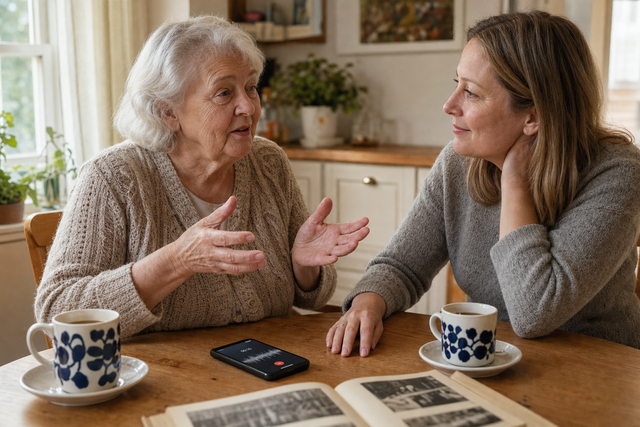
Yes, you can make the entire book on someone else's behalf. Your loved one only needs to talk — no writing, no touching the app, not even their own account. You create the project, record or upload the audio, edit the text, and order the printed book. They tell the stories; you handle the rest.
This article is for anyone who wants to make a book for an elderly parent or grandparent — or alongside them. For the full overview of the process and different starting points, see our guide to writing a book about your life. If you're writing about them rather than helping them tell it themselves — as their biographer, in your own words — that's a different job, and we've covered it in how to write a biography about someone else.
Can you really make the whole book on someone else's behalf?
Yes. You open the project under your own account, record your loved one's stories (or they talk while you hold the phone), the AI transcribes and organizes the text into chapters, you edit and add a cover — and finally order the printed book. Your loved one never has to log in to anything themselves.
Do you have to make it together, or can you do it entirely on your own?
Both work. Sit beside them and record together, or run the whole project independently — record during a visit, take the audio home, and assemble the book later on your own time. Neither approach is "more correct."
Many families land somewhere in between: the first recordings happen together at the kitchen table, and the rest — checking the transcript, shaping the chapters, designing the cover — gets handled afterward, on your own schedule. Your loved one's role can be limited entirely to talking; the technical work stays with you.
What you actually need — one account, a phone, and a computer
One account works across every device. Log in with the same credentials on your phone and your computer — the project stays the same regardless of which device you use.
The setup that works best for most people is a familiar one: record on a phone at the kitchen table, wherever conversation flows naturally. Then assemble the book on a computer — the cover editor and planning out multiple chapters is far easier on a bigger screen with a mouse than on a phone's small display. The phone handles the moment, the computer handles the work.
Why doesn't transcription tell speakers apart — and what does that mean in practice?
Transcription currently doesn't distinguish between speakers: the whole conversation comes out as one continuous text stream. So when you interview a loved one, keep your own questions short and let them do most of the talking — that way there's noticeably less of your voice mixed into their story.
This isn't a flaw that breaks the book — it's simply something worth planning around. Ask a short question ("What happened after that?"), then give them space, and mark your loved one as the recording's main speaker. If some mixed-up speech ends up in the text — your question cutting into their sentence — the transcript is freely editable, so you can tidy up any overlap afterward. For a deeper guide to questions and interview technique, see recording elders' stories.
What if my loved one speaks with a strong dialect or accent — can the AI still handle it?
A strong dialect can cause small transcription inaccuracies, but the text stays close enough to the original that the AI writing the chapters handles it well. Direct quotes are easy to fix afterward, since the whole text remains freely editable.
You don't need flawless pronunciation or dialect-free speech. Let your loved one talk exactly the way they naturally do — that's precisely the voice the book is meant to capture.
How do I interview an elderly or frail loved one gently?
Keep sessions short, 15–30 minutes at a time — anything longer tires them out without improving the stories. Never correct your loved one's memory, even if a date or detail seems wrong to you. Even an imperfect memory is worth preserving.
An elderly or frail relative can't manage a long session, and they don't need to. One short, warm conversation at a time is enough — the book comes together gradually from many small pieces. For a deeper guide to questions, jogging memory, and difficult topics, read recording elders' stories. And if the grandparent wants to be the one making the book themselves, point them to a book for your grandchild — same idea, but they speak directly to their own grandchild.
How the project moves forward, step by step
In practice the whole process breaks down into a handful of repeatable steps, which you can do in any order and at any pace:
- Create the book project. Give it a name and pick a style — a memoir or a free-form narrative, for instance.
- Record or upload audio. Record in the app on your phone, or upload old recordings, interview tapes, or voice messages you already have.
- Let the AI transcribe and summarize. Every recording becomes text with a short summary of its main topics, so you can see what it covers without re-listening.
- Edit the text freely. Fix names, tidy up mixed-up passages, remove filler words. Nothing is final until you decide it is.
- Let the AI shape the chapters. Once several recordings have accumulated, the AI suggests a chapter structure and drafts a readable version of each one.
- Design the cover and order the book. Design a cover (or use a ready-made one) and order a printed copy, or download it as an e-book.
No step requires your loved one's presence beyond the recording itself — and even that can happen in several short sittings over a few weeks.
Why this is worth doing now, not "someday"
Stories don't disappear because they're unimportant. They disappear because no one got around to saving them in time. Memory can fade, health can change — and no one knows how many more times a loved one will still be able to tell the same story again.
There's no need to turn this into a heavy project or an anxious deadline. It's enough to start with one short recording today. The rest can happen tomorrow, next week, or a little at a time all autumn — as long as it starts.
What happens to the finished book — printed, e-book, or audiobook?
Once the text is edited to your liking, order it as a printed copy — softcover or hardcover, delivered to you. You see the exact total price before you order, no guessing in advance. Or download it as an e-book (EPUB, PDF, or Word) for personal use or to share with the family. An audiobook narrated in your loved one's own voice is coming later.
If you'd like the whole family to have a copy, The Keepsake bundle (€99) includes the credits to make the book plus one printed softcover copy, and The Legacy Edition (€169) the same in hardcover — an easy way to make sure the project ends up as an actual book you can hold.
Also worth knowing: recording, AI summaries, and automatic organizing are all free. Only turning speech into text costs credits — one per minute recorded.
You can start for free — new users get 100 credits as a signup gift, no credit card required. Create the project today and record the first story on your very next visit.
Frequently Asked Questions
Does my loved one need their own account?
Not necessarily. You can run the whole project under your own account — create the book, record, edit, and order the printed copy. Your loved one never has to log in to the app or even have an email address, if they'd rather not.
Can I record on one device and continue the project on another?
Yes. One account works across every device. You can record on your phone during a visit and later continue the same project on a computer — for designing the cover and polishing chapters, which is easier on a larger screen.
What if the recording picks up both my voice and my loved one's?
Transcription doesn't tell speakers apart, so the text comes out as one stream. Keep your own questions short during the interview and let your loved one do most of the talking. Afterward, you can tidy up any overlapping speech in the editable transcript and mark your loved one as the book's main speaker.
Does dialect or accent affect the result?
A strong dialect or accent can cause small transcription inaccuracies, but the text stays close enough to the original that the AI writing the chapters handles it well. Individual quotes are easy to fix afterward, since the whole text remains freely editable.
How long should recording sessions be for an elderly loved one?
15–30 minutes at a time is a good starting point — a longer session tires them out without improving the stories. Several short sessions spread over a few weeks usually produce a richer, more varied result than one long recording.
What if my loved one's memory slips or details get mixed up?
That's fine. Don't correct or question their memory during the recording — even an incomplete memory is a valuable record exactly as it's told. For more tips on supporting memory during an interview, see recording elders' stories.
What format will the finished book come in?
You can order it as a printed book — softcover or hardcover, delivered to you — or download it as an e-book in EPUB, PDF, or Word format. An audiobook narrated in your loved one's own voice is coming later.