Capturing Tacit Knowledge Before Retirement — Turn Expertise Into a Book
14 June 2026
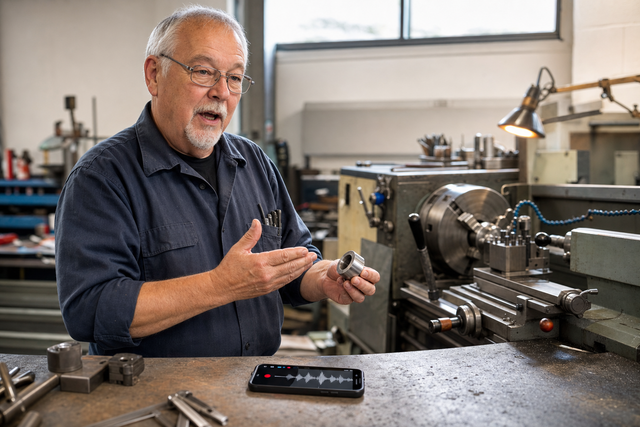
Tacit knowledge is captured before retirement when a long-serving expert tells what they know out loud and it's gathered into a structured book or handbook. What matters most is recording exactly what no manual contains: judgement, exceptions, and why something is done a certain way. The easiest path is by speaking — the expert explains their work in their own words, and AI transcribes the speech, organises it into chapters and turns it into fluent text. You don't need a writer; you need experience and a few spoken sessions.
Every year a large cohort of experts retires, and with them goes knowledge built up over decades that was never written down anywhere. It's in the machinist's ear, the nurse's hands, the entrepreneur's instinct and the foreman's ability to sense what's about to go wrong before it does. This guide explains how to capture it as a book — whether you're the one retiring or an employer who doesn't want to lose a departing expert's knowledge. If instead you want to tell your own life or career story more broadly, see the general guide on writing a book about your own life.
What is tacit knowledge, and why does it vanish at retirement?
Tacit knowledge is expertise built up through experience that the practitioner uses automatically but has never put into words. It's the opposite of documented knowledge: instructions, manuals and process diagrams tell you what is done, but tacit knowledge is how an experienced person actually works — what they base a decision on, when they depart from the rule book, and how they recognise a problem before it surfaces.
That's exactly why it vanishes at retirement. Tacit knowledge isn't stored in any system, because the person who holds it often doesn't realise they have it — to them it just feels like common sense. When they leave, the knowledge leaves with them, and the next generation has to relearn the same things through mistakes. This is why capturing tacit knowledge in good time, before the last working day, is more valuable than updating any existing manual.
Why capture tacit knowledge by speaking rather than writing?
Because an expert can tell you how they work, but rarely has the energy or time to write it down. Ask a seasoned practitioner to produce a manual and the project almost always stalls: the blank page is an unfamiliar tool, and there's no time to sit at a computer. Ask them to talk about how they do the job, and the words come, hour after hour.
Speaking also reaches knowledge that writing doesn't. When someone explains their work out loud — ideally while doing it, or just afterwards — they mention, in passing, things they'd never put in a formal procedure: "always check this before you carry on," or "that's how you can tell it's going wrong." Those very asides are the tacit knowledge you set out to capture. A book grows from speech more naturally than a manual grows from a blank page — and a spoken book can be made with AI so that fluency isn't down to the teller.
Who makes the book — the person retiring or the employer?
Either, and often best together. The retiring expert is the only source of the knowledge, but the capture can be set in motion by an employer or a younger colleague who wants to make sure the expertise doesn't disappear. The result is the same: a book or handbook that preserves what one person learned over the years.
When the initiative comes from the expert themselves, the book tends to be more personal — a kind of professional testament, carrying the stories and principles learned along the way. When it comes from the organisation, it's essentially onboarding and continuity: the departing expert's knowledge passes to a successor and the team. The easiest way to do the latter is an interview: a younger colleague asks and the person retiring tells. That two-person way of working uses the same technique as recording an older person's stories — ask open questions, let the teller ramble, and record everything.
What expertise is worth capturing?
Capture what a newcomer can't learn from a manual: judgement, exceptions and reasons. Routines and official processes are usually documented somewhere already — repeating them adds nothing. The most valuable layer is the one that falls between the instructions: how to tell an ordinary situation from an exceptional one, what to do when no model fits, and what experience has taught even when the rule says otherwise.
In practice, narrow the subject to one clear area of expertise, not a whole career. Don't try to capture "everything Pekka knows," but, say, how Pekka diagnoses a machine fault from its sound, or how he prices an unusual order. A narrow but deep book gets finished — and serves a successor better than a broad but shallow overview. If there are many areas, make several short books rather than one that's never completed.
How to capture tacit knowledge by speaking — step by step
The process is the same whatever the field. When the knowledge is gathered by speaking, the most laborious stage — filling the blank page — drops away entirely.
1. Narrow the subject and decide the method
Choose one area of expertise and one reader: the future successor, the team, or the wider profession. Write yourself a one-sentence promise: "This book teaches [whom] how to [what]." At the same time, decide whether the expert speaks alone or someone interviews them — both work.
2. Gather the knowledge by speaking — solo or interviewed
Let the expert tell their work out loud, as if advising a successor standing beside them. The best moment is often at the work itself: a step can be explained while it's done, even with hands full. If you use an interview, a colleague asks and the expert answers freely. On Vellu.ai, recording is free, and each recording can be tagged with the speaker, so making a multi-narrator or interview-style book is easy.
The expert's hardest obstacle is that they don't think to explain the obvious. It helps that you can ask the AI for interview questions that reveal the gaps — exactly the things the practitioner knows so well they never mention them. The questions are categorised by type (backstory, detail, timeline, reflection) and sharpen as material accumulates. That way the tacit knowledge is captured in full, not just the parts the teller happens to remember.
3. Organise the knowledge into chapters
Once you have material, it needs ordering. AI tags each recording with 3–8 topic tags and suggests a chapter breakdown you can accept or edit. For a handbook or reference work, a suitable style is often journalistic or conversational — you choose it in the book settings, and the text adapts accordingly. A good rule of thumb is one chapter, one skill or step.
4. Add images, diagrams and examples
A professional handbook lives on images: a machinist needs photographs, a process expert diagrams, a maker step-by-step shots. You can add your own photos and drawings to chapters or generate images with AI directly in the editor. Images carry over into the finished e-book and PDF too. Concrete worked examples — "one time this situation came up, and here's how it was solved" — are often the most valuable content, so encourage telling them.
5. Finish and share
Finally the text is proofread and finished. You can order the finished book as a printed copy delivered to you, or download it right away as an e-book (EPUB), a print-ready PDF (trim sizes including A5, B5 and 6 × 9 inches) and a Word file — handy if you want to fold it into the organisation's own onboarding material or polish it yourself. An AI-voiced audiobook is coming later. We cover the whole finishing stage in more detail in the guide on speaking your book into being.
The easiest way: speak the expertise into a book
"I can't write a manual — I just do the job." This is the most common reason for never capturing the knowledge — and at the same time the most pointless. Capturing knowledge takes experience, not writing skill, and that you have. A book doesn't have to be written word by word: you can tell it out loud, and AI handles the rest.
You record your expertise in free order — the way you'd explain it to your successor. Vellu.ai transcribes the speech, groups the topics, suggests a structure for the book, and turns the spoken knowledge into fluent text. You decide what makes the cut. Recording, AI summaries and topic-tagging are free; transcription costs one credit per minute of audio, and new users get 100 free credits when they start, so trying it costs nothing. The same approach works when you turn a hobby or special field into a nonfiction book — it's always about turning experience into shareable knowledge.
Where do you start?
Tacit knowledge isn't captured by planning but by beginning. Do this:
- Choose one subject. Pick the area of your expertise whose loss would hurt a successor or the organisation most.
- Choose one reader. Decide whether you're writing for the future successor, the whole team, or the wider profession.
- Tell the first thing. Record one step, rule of thumb or worked example today. That's the first page of your book.
The most important thing isn't a perfect plan but that the expertise begins turning into words before the last working day arrives. Start from one thing you know — the book grows from there.
Frequently Asked Questions
What does tacit knowledge mean?
Tacit knowledge is expertise built up through experience that a practitioner uses automatically but has never put into words. It's judgement, instinct and the understanding behind the rules: when to depart from an instruction, how to spot a problem in advance, and why something is done a particular way. Its opposite is documented knowledge — written procedures and processes. Precisely because tacit knowledge is written down nowhere, it disappears when its holder retires.
How can you transfer tacit knowledge from a retiring employee?
The most effective way is to let the expert tell their work out loud and record the speech. In practice this happens either by the expert recording their expertise themselves in free order, or by a younger colleague interviewing them. The speech is transcribed and organised into a book or handbook the successor can read. This method also reaches the knowledge an expert would never put in a formal procedure — the asides and rules of thumb that are the core of tacit knowledge.
Does the person retiring need to know how to write to make a handbook?
No. Capturing knowledge takes experience, not writing skill. The expert can tell what they know out loud in their own words, and AI transcribes the speech, organises it into chapters and turns it into fluent text. For many this is the easiest way, because it removes the most laborious stage — filling the blank page — and lets them focus on what they do best: explaining their work. Vellu.ai is built for exactly this.
Can tacit knowledge be captured by interview?
Yes, and for many organisations it's the most natural way. A younger colleague asks and the retiring expert answers freely; the conversation is recorded. Each recording can be tagged with the speaker, so an interview-style, multi-narrator book is easy to assemble. An interview also helps surface the obvious: an outside questioner thinks to ask exactly what the expert would skip over as too familiar.
Who should a tacit-knowledge book be written for?
Choose one main reader before you start. There are usually three options: the future successor who continues the work; the whole team or organisation whose continuity is at stake; or the wider profession, in which case the book can become a publishable reference work. The reader decides the tone and level of detail, so settle it before gathering material — it's not worth trying to cram all three into one book.
Who owns the finished book and its knowledge?
The book and its content belong to the author. You can download the book as an e-book, a PDF and a Word file and share it freely with a successor, a team or more widely. If the book is made at the employer's initiative and on work time, it's worth agreeing in advance how the finished material is used and shared — best settled with the organisation before the project starts, not after.